46
National patents
Selecting flooring for medical offices requires balancing infection control, durability, and aesthetic standards. The material must withstand frequent cleaning with disinfectants while providing slip
Order this product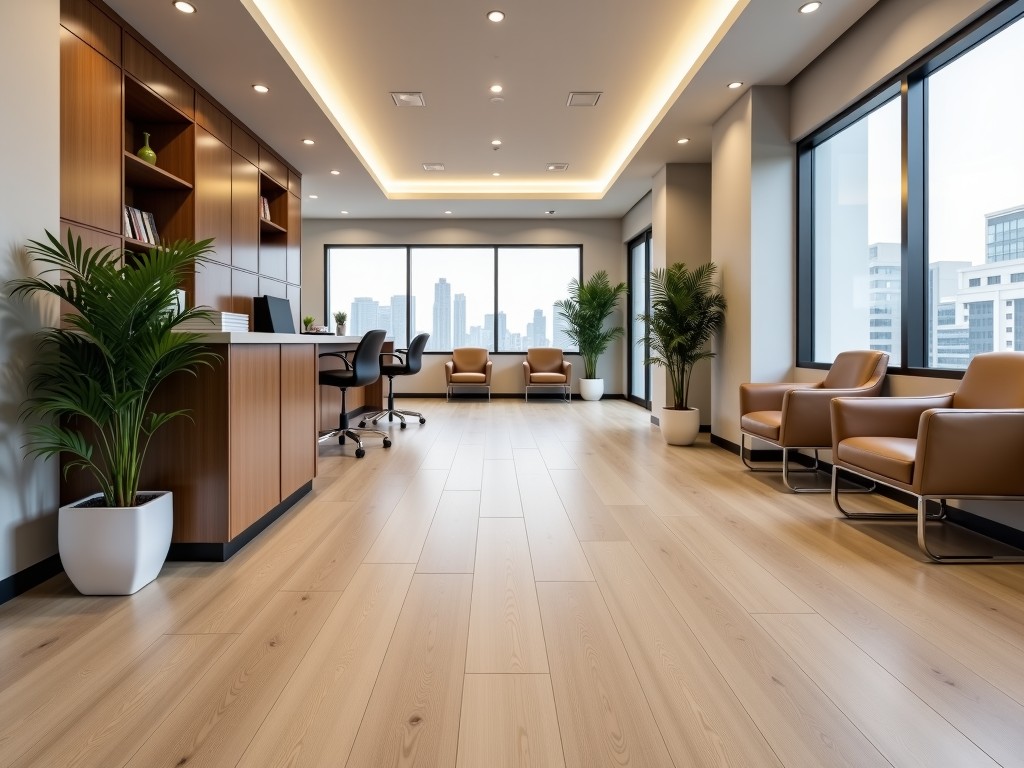
Selecting flooring for medical offices requires balancing infection control, durability, and aesthetic standards. The material must withstand frequent cleaning with disinfectants while providing slip resistance and comfort for staff and patients.
Our supplier network sources products that meet ASTM F2170 for moisture resistance, ISO 10545 for wear, and have low VOC emissions compliant with CDPH Section 01350.
| Property | Typical Value | Test Standard |
|---|---|---|
| Total Thickness | 2.0 mm – 3.0 mm | ASTM F386 |
| Wear Layer Thickness | 0.5 mm | ASTM F410 |
| Slip Resistance (Static Coefficient of Friction) | ≥0.6 | ASTM D2047 |
| Chemical Resistance (Disinfectants) | No degradation after 24h exposure to 70% isopropyl alcohol | ASTM F925 |
| VOC Emissions | ≤0.5 mg/m³ | CDPH Section 01350 |
Waiting areas benefit from low‑glare finishes that reduce eye strain while maintaining a clean appearance. Examination rooms require flooring that can be quickly disinfected between patients without staining or degradation.
Hallways and corridors experience high foot traffic and equipment carts; a wear layer of at least 0.5 mm ensures longevity under rolling loads. Procedure rooms often need antimicrobial surfaces to support sterile protocols.
Acoustic performance is also considered; rubber or cushioned vinyl reduces impact noise, improving speech privacy in consultation spaces.
Flooring is delivered in rolls or tiles with factory‑applied adhesive backing, allowing direct‑to‑substrate installation over concrete, plywood, or existing vinyl. Seam welding kits are provided for sheet products to create impermeable joints.
Routine maintenance involves neutral pH cleaners; periodic buffing restores surface gloss on LVT. Manufacturer‑recommended disinfectants (e.g., quaternary ammonium) do not affect wear layer integrity when used per guidelines.
Inspection checklists include seam integrity, adhesion strength (minimum 1.5 MPa), and surface flatness (≤1 mm deviation over 2 m).
Color matching is achievable through digital pigment dosing, enabling exact correlation with corporate branding or wayfinding schemes. Thickness can be adjusted in 0.2 mm increments to meet specific load requirements without altering the wear layer.
Edge profiles (straight, beveled, coved) are selectable to facilitate transitions to wall bases or to create flush installations with cabinetry.
Each production lot undergoes inline thickness gauging, wear‑layer abrasion testing (Taber Abrader, 1000 cycles), and chemical immersion checks. Finished rolls are inspected for surface defects under 500 lux lighting, with acceptance criteria of ≤0.1 mm² defect per m².
Documentation includes material safety data sheets (MSDS), test reports, and installation guidelines, supplied electronically with each shipment.
Ready to discuss your project’s flooring requirements? Our technical team can provide substrate analysis, sample coordination, and a detailed quotation.
Request a QuoteNational patents
Vinyl flooring line
K+ SQ.M capacity
Founded