46
National patents
The modular carpet tile system described here is intended for environments where floor coverings experience constant foot traffic, frequent equipment movement, and periodic cleaning cycles. Each tile
Order this product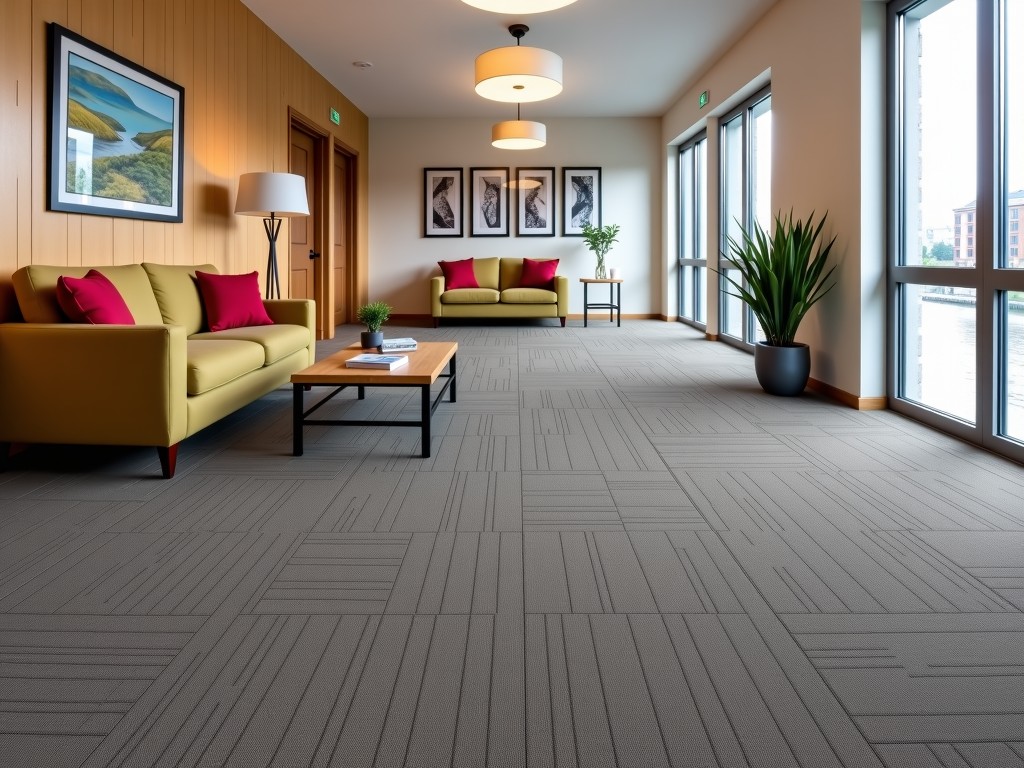
The modular carpet tile system described here is intended for environments where floor coverings experience constant foot traffic, frequent equipment movement, and periodic cleaning cycles. Each tile combines a wear-resistant face yarn with a dimensionally stable backing to maintain appearance and performance over many years. The following sections detail the engineering characteristics that allow specifiers to predict service life and maintenance requirements.
The face yarn is typically solution-dyed nylon 6,6 with a denier range of 1000‑1300 dtex, providing inherent colorfastness to UV exposure and resistance to bleaching agents. Pile height is set between 3.0 mm and 4.5 mm, and the tuft gauge is 1/10 in (2.54 mm) with a stitch rate of 8‑10 stitches per cm, yielding a pile weight of approximately 450‑550 g/m².
Backing options include a reinforced polyvinyl chloride (PVC) layer, a bitumen‑based compound, or a recycled polyester fleece, each selected for specific load‑bearing and moisture‑barrier requirements. The backing thickness ranges from 1.5 mm to 2.5 mm, contributing to overall tile thickness of 5.0‑7.0 mm and a nominal weight of 4.0‑5.5 kg per tile.
Abrasion resistance is evaluated using the Taber Abrader (CS‑10 wheels, 500 g load) and typically shows a weight loss of less than 0.08 g after 1000 cycles, corresponding to a TAR (Taber Abrasion Rating) suitable for commercial classifications EN 1307 class 33. Static dissipative properties are achieved by incorporating conductive carbon filaments into the yarn, yielding a surface resistance of 10⁶‑10⁸ Ω as measured by ANSI/ESD STM7.1.
Fire performance meets ASTM E648 Class I (critical radiant flux ≥0.45 W/cm²) and CAN/ULC‑S102.2, allowing installation in corridors and exitways without additional fire‑retardant treatments. Slip resistance, measured by the pendulum test (wet), yields a PTR value of ≥45, satisfying ADA recommendations for level surfaces.
Dimensional stability under temperature cycling (‑20 °C to +80 °C) is maintained within ±0.2 % in both length and width, verified by ISO 2551. The compressive static load capacity exceeds 4 MPa (≈580 psi) before permanent deformation, ensuring suitability under heavy furniture and rolling loads.
Because each tile measures 500 mm × 500 mm (or 600 mm × 600 mm upon request), damaged units can be removed and replaced without disturbing adjacent flooring, reducing repair time from hours to minutes. This interchangeability also allows directional patterns to be altered on‑site to conceal wear or accommodate layout changes.
Inventory overhead is minimized; facilities typically keep a spare stock of 2‑5 % of total area, which translates to far less material waste compared with broadloom replacement. Installation can be performed with pressure‑sensitive adhesives or loose‑lay interlocking systems, both of which accommodate subfloor tolerances of up to 3 mm.
National patents
Vinyl flooring line
K+ SQ.M capacity
Founded