46
National patents
Wet floors, grease spills, and continuous foot traffic create a high risk of slips and falls in food‑service environments. Effective flooring must maintain a reliable coefficient of friction even
Order this product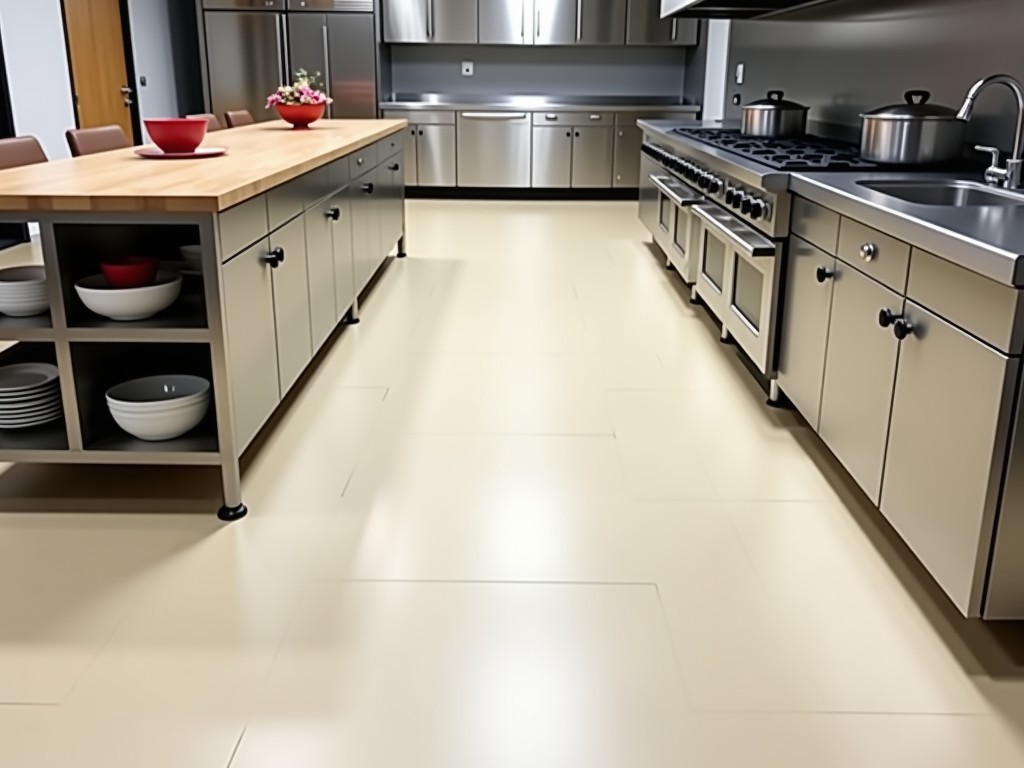
Wet floors, grease spills, and continuous foot traffic create a high risk of slips and falls in food‑service environments. Effective flooring must maintain a reliable coefficient of friction even when contaminated with water, oil, or food residues.
Selecting a surface that retains its anti‑slip properties over years of service reduces accident rates, lowers insurance premiums, and supports compliance with occupational safety regulations.
The flooring consists of a polyurethane‑based matrix reinforced with finely graded alumina granules and a proprietary silica additive. This combination yields a homogeneous wear layer typically 2 mm to 3 mm thick.
A reinforced backing layer of PVC‑coated polyester provides dimensional stability and facilitates adhesion to concrete or cementitious substrates. The overall product weight averages 3.5 kg/m², allowing easy handling during installation.
| Property | Typical Value | Test Method |
|---|---|---|
| Static Coefficient of Friction (wet) | ≥0.60 | ASTM C1028 |
| Dynamic Coefficient of Friction (wet) | ≥0.55 | ASTM D2047 |
| Abrasion Resistance (volume loss) | ≤80 mm³ | ASTM D4060 |
| Chemical Resistance (10 % NaOH, 24 h) | No visible degradation | ISO 2812‑1 |
| Thermal Expansion Coefficient | 50 × 10⁻⁶ / °C | ASTM D696 |
Values represent typical results from production lots; actual performance can be confirmed with project‑specific testing.
In each setting, the flooring’s slip resistance remains effective despite varying contaminant types, reducing the likelihood of workplace accidents.
Substrate must be clean, dry, and level to within ±3 mm over a 2 m radius. Any laitance or curing compounds should be removed by mechanical grinding.
A two‑component polyurethane adhesive, applied at a rate of 300 g/m², provides optimal bond strength. Seams are sealed with a compatible flexible filler to prevent liquid ingress.
Ambient temperature during installation should stay between 10 °C and 30 °C, with relative humidity below 80 % to ensure proper curing.
Routine cleaning involves pH‑neutral detergents applied with a soft‑bristle scrubber; abrasive pads should be avoided to preserve the wear layer.
For stubborn grease deposits, a diluted alkaline cleaner (pH 9‑10) may be used for a maximum contact time of five minutes, followed by thorough rinsing.
Periodic recoating with a thin polyurethane top‑coat, typically every 12‑18 months depending on traffic intensity, restores surface texture and extends service life.
Each batch undergoes in‑line viscosity monitoring during mixing to ensure consistent resin‑to‑filler ratio. Finished sheets are sampled for coefficient of friction using a portable tribometer at five random points.
Visual inspection checks for color uniformity, absence of bubbles, and edge straightness. Dimensional tolerances are verified with laser‑scanned profiles, maintaining width variation under ±0.5 mm.
Final product is packaged with protective polyethylene film and edge guards to prevent damage during transit.
Specifications such as thickness, filler granule size, and backing material can be adjusted to meet unique project demands, subject to minimum order quantities.
To discuss how this flooring solution can meet the safety and durability requirements of your commercial kitchen project, please contact our technical team.
National patents
Vinyl flooring line
K+ SQ.M capacity
Founded