46
National patents
Polished concrete flooring is created by mechanically grinding, honing, and polishing a concrete slab to achieve a dense, reflective surface. This process enhances wear resistance, reduces dust
Order this product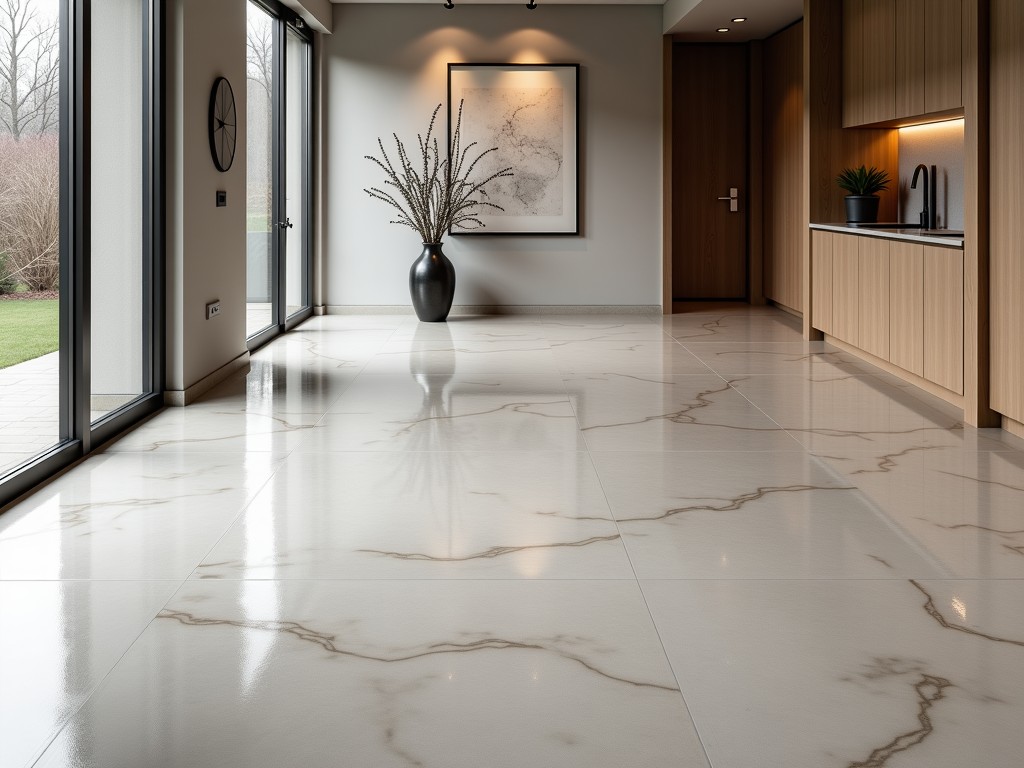
Polished concrete flooring is created by mechanically grinding, honing, and polishing a concrete slab to achieve a dense, reflective surface.
This process enhances wear resistance, reduces dust generation, and provides a low‑maintenance finish suitable for residential interiors.
Typical slab thickness ranges from 80 mm to 120 mm for residential applications, providing sufficient structural depth for grinding.
Compressive strength after curing usually exceeds 25 MPa, ensuring the substrate can withstand polishing abrasion.
Surface gloss is measured in gloss units (GU) and can be adjusted from 20 GU (matte) to 80 GU (high shine) depending on the polishing pad sequence.
The polishing process uses water‑based densifiers that add negligible volatile organic compounds (VOC), typically below 5 g/L.
Final floor density after densification can reach 2.4 g/cm³, improving abrasion resistance and reducing permeability.
First, the concrete slab is inspected for levelness and any surface defects are repaired with polymer‑modified mortar.
Next, a series of metal‑bonded diamond grinding pads, ranging from 30 grit to 120 grit, remove laitance and expose the aggregate.
Subsequently, resin‑bonded pads of 50 grit to 400 grit hone the surface, preparing it for polishing.
Finally, progressively finer resin‑bonded pads (800 grit to 3000 grit) are used to achieve the desired gloss, followed by application of a liquid silicate densifier and a penetrating sealer.
In residential settings, polished concrete offers a seamless surface that eliminates joints where dirt can accumulate, contributing to better indoor air quality.
Its high thermal mass helps moderate indoor temperature fluctuations, reducing heating and cooling loads.
The finish is compatible with radiant floor heating systems, allowing efficient heat transfer.
Each batch undergoes slab flatness testing using a 2‑meter straightedge, with tolerance limited to 3 mm over the length.
Gloss uniformity is verified with a gloss meter at five points per 10 m², requiring variation ≤ 5 GU.
Adhesion of the densifier is checked by pull‑off testing, targeting a minimum bond strength of 1.5 MPa.
Clients can select from a range of decorative aggregates, including quartz, granite, and recycled glass, to influence the final appearance.
Color stains can be applied before polishing to achieve hues ranging from warm greys to deep charcoals.
Gloss level, edge treatment (beveled, bullnose, or square), and slip‑resistant additives are all adjustable per project specification.
| Property | Typical Range | Unit |
|---|---|---|
| Slab thickness | 80–120 | mm |
| Compressive strength | ≥25 | MPa |
| Gloss level | 20–80 | GU |
| VOC content (densifier) | <5 | g/L |
| Floor density after densification | 2.3–2.5 | g/cm³ |
Q: Can dimensions be customized?
A: Yes, slab dimensions are cut to project‑specific lengths and widths, with tolerances ± 5 mm.
Q: What information is required before quotation?
A: Required details include slab area, desired thickness, aggregate type, gloss target, and any special edge or slip‑resistance requirements.
Q: How is quality inspected?
A: Quality is verified through flatness, gloss uniformity, and densifier adhesion tests as described in the quality control section.
Q: What is the typical production lead time?
A: Lead time ranges from 2 to 4 weeks depending on order size and customization complexity.
For technical data sheets, sample arrangements, or project‑specific inquiries, contact our engineering team.
Contact UsNational patents
Vinyl flooring line
K+ SQ.M capacity
Founded