46
National patents
Epoxy floor coatings form a continuous, seamless membrane that protects concrete substrates from chemical spills, mechanical impact, and microbial growth. In commercial kitchens, where exposure to
Order this product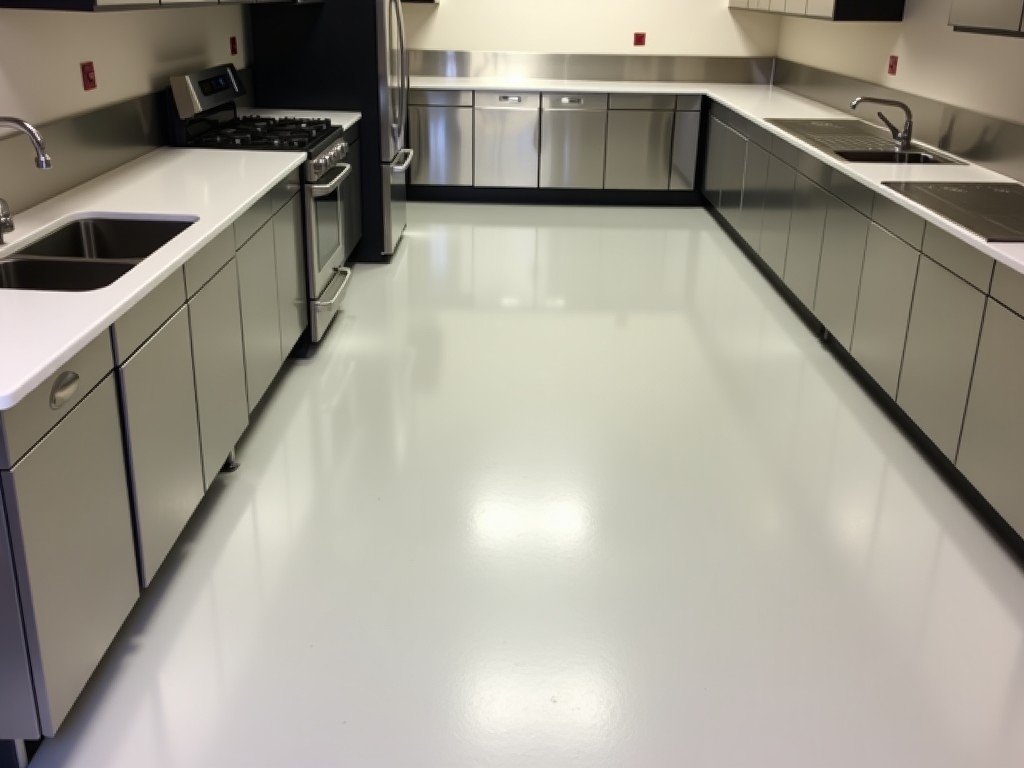
Epoxy floor coatings form a continuous, seamless membrane that protects concrete substrates from chemical spills, mechanical impact, and microbial growth. In commercial kitchens, where exposure to fats, oils, acidic foods, and aggressive cleaning agents is constant, the coating must maintain adhesion and performance over years of daily wash‑down cycles.
Compressive strength typically ranges from 50 MPa to 80 MPa, providing sufficient load‑bearing capacity for heavy kitchen equipment such as walk‑in coolers, cooking ranges, and pallet jacks without cracking or delamination.
Tensile strength falls between 20 MPa and 35 MPa with elongation at break of 2 %‑4 %, offering impact resistance that absorbs dropped utensils and reduces the risk of surface chipping.
Shore D hardness values of 70‑85 indicate a hard, abrasion‑resistant surface that withstands abrasive scrubbing and foot traffic while retaining a slight flexibility to accommodate substrate movement.
Chemical resistance testing per ASTM D1308 shows minimal swelling or softening when exposed to saturated fatty acids, citric acid (up to 10 %), sodium hydroxide solutions (up to 5 %), and commercial detergents, ensuring the coating remains intact during routine sanitizing procedures.
Volatile organic compound (VOC) content is kept below 50 g/L, meeting low‑emission standards such as SCAQMD Rule 1113; at 23 °C and 50 % relative humidity the pot life is approximately 20 minutes and the coating reaches functional cure in 24 hours.
The system tolerates continuous service temperatures up to 80 °C and short‑term spikes to 120 °C, with a thermal shock resistance that prevents cracking when hot liquids are spilled onto a cool floor.
Slip resistance is achieved by broadcasting graded aluminum oxide or silica aggregate; the resulting static coefficient of friction (COF) measures 0.6 – 0.75 (ASTM D2047), satisfying OSHA and ADA requirements for wet kitchen areas.
A seamless epoxy membrane eliminates joints where food particles and moisture can accumulate, simplifying cleaning protocols and supporting compliance with HACCP and FSMA guidelines. The non‑porous surface resists microbial colonization, reducing the likelihood of biofilm formation on the floor.
Because the coating bonds directly to properly prepared concrete, it accommodates the slight movement caused by temperature variations in cooking zones without cracking, thereby extending the service life of the flooring system in high‑heat environments.
| Property | Standard Epoxy | High‑Build Epoxy | Urethane‑Modified Epoxy |
|---|---|---|---|
| Compressive Strength (MPa) | 55‑70 | 65‑80 | 60‑75 |
| Tensile Strength (MPa) | 22‑30 | 25‑35 | 20‑28 |
| Shore D Hardness | 72‑78 | 78‑84 | 70‑76 |
| VOC (g/L) | 45 | 40 | 38 |
| Cure to Walk‑On (hrs @23°C/50%RH) | 24 | 24 | 20 |
| Slip Resistance (COF) | 0.60‑0.68 | 0.65‑0.72 | 0.62‑0.70 |
Surface preparation requires achieving a concrete surface profile (CSP) of 3‑5 via shot blasting or diamond grinding, followed by vacuum cleaning to remove dust and laitance. A moisture barrier primer is applied when relative humidity exceeds 75 % to prevent blistering.
The epoxy resin and hardener are mixed in a 2:1 by volume ratio using a low‑speed drill mixer; pot life is monitored and the material is applied with a notched squeegee to achieve the target wet film thickness, then back‑rolled with a ⅜‑inch nap roller to release entrapped air.
Ambient conditions during placement should stay between 10 °C and 30 °C with relative humidity below 80 %; deviations extend cure time or affect film formation. After the final coat, the floor is kept dry and free of traffic for at least 24 hours before light use and 72 hours before heavy equipment loading.
In‑process checks include wet film thickness measurement with a notch gauge, targeting ±10 % of the specified dry film thickness. After cure, adhesion is verified by pull‑off testing per ASTM D4541, accepting values ≥1.5 MPa. A holiday detector identifies pinholes or thin spots that could compromise chemical resistance.
Thickness is confirmed using a magnetic dry film thickness gauge on cured sections, and visual inspection ensures uniform color and gloss. All test results are documented in a batch‑specific quality record that accompanies the shipment to the client.
For technical datasheets, sample panels, or a project‑specific quotation, please contact our engineering team.
Request Technical InformationNational patents
Vinyl flooring line
K+ SQ.M capacity
Founded