46
National patents
Slip resistance in commercial kitchens depends on both surface texture and material hardness under wet, greasy conditions. The tiles described here are engineered to meet DIN 51130 R11 classification
Order this product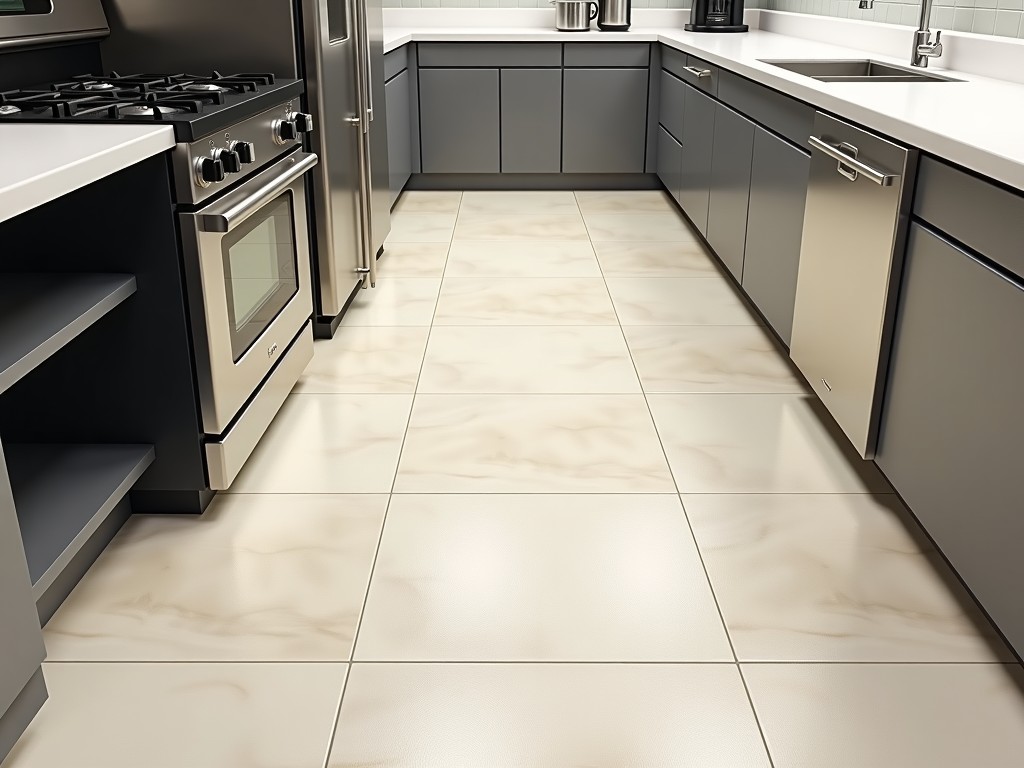
Slip resistance in commercial kitchens depends on both surface texture and material hardness under wet, greasy conditions. The tiles described here are engineered to meet DIN 51130 R11 classification while maintaining a compressive strength suitable for heavy equipment traffic.
Manufacturers adjust the grit size of the abrasive additive and the vitrification temperature to achieve a consistent coefficient of friction without compromising wear resistance. This approach reduces the likelihood of hydroplaning when water or oil accumulates on the floor.
A base body of fully vitrified porcelain provides low water absorption (<0.5 %) and high flexural strength (>35 MPa). The surface layer incorporates a graded blend of silicon carbide and alumina particles, graded from 30 µm at the substrate to 120 µm at the wear face.
During firing at 1240 °C, the abrasive particles become mechanically locked within the glassy matrix, creating a durable micro‑texture that resists smoothing under repeated cleaning cycles. The resulting porosity remains below 0.2 %, limiting bacterial harborage.
The tiles achieve a wet pendulum test value (BPN) of 45 ± 3, corresponding to DIN 51130 R11, when tested according to ASTM E303. This level is appropriate for areas where water, oil, and food residues are present.
Dry slip resistance exceeds BPN 60, ensuring safety during routine dry‑mopping. The abrasive layer retains >80 % of its initial texture after 10 000 cycles of Taber abrasion (CS‑10 wheels, 500 g load).
Chemical resistance testing shows no loss of slip performance after 24 h immersion in 5 % sodium hydroxide or 10 % acetic acid, confirming suitability for aggressive cleaning agents.
Standard thicknesses range from 8 mm to 12 mm, with tolerances of ±0.3 mm. Edge straightness is held to ≤0.2 mm deviation over a 300 mm length, facilitating tight grout joints.
Customization covers size, surface pattern, and color. Available formats include 300 × 300 mm, 400 × 400 mm, and 600 × 600 mm modules, with the ability to produce non‑standard lengths up to 1200 mm upon request.
All custom features are defined in the project specification sheet and validated through first‑article inspection before mass production.
| Property | Typical Value | Test Method |
|---|---|---|
| Water Absorption | ≤0.5 % | ASTM C373 |
| Flexural Strength | ≥35 MPa | ASTM C648 |
| Wet Pendulum BPN | 45 ± 3 | ASTM E303 |
| Abrasion Loss (10 000 cycles) | ≤0.15 mm³ | ASTM C1243 |
| Chemical Resistance (NaOH 5 %) | No change in BPN | ISO 10545‑13 |
| Thickness Tolerance | ±0.3 mm | ISO 10545‑2 |
Values represent typical production lots; actual figures may vary with specific color pigments or surface treatments and are confirmed during project‑specific qualification.
Commercial kitchens experience constant exposure to water, fats, and particulate matter, creating conditions where conventional glazed tiles may become hazardous. The micro‑abrasive surface maintains traction even when a thin film of oil forms, reducing slip incidents in prep zones and cooking lines.
Beyond kitchens, the tiles suit food processing plants where high‑pressure washdowns are routine; the low absorption prevents moisture migration into the substrate, limiting mold growth. Hospital service corridors benefit from the same properties, as the surface tolerates frequent disinfectant exposure without degradation.
Installation over concrete substrates with a flexible polymer‑modified mortar accommodates slight substrate movement, preserving joint integrity under thermal cycling from hot equipment.
Each production lot undergoes a three‑stage verification: raw material particle size distribution, green body density after pressing, and final fired tile dimensions. Statistical process control charts monitor key parameters such as firing peak temperature and cooling rate to ensure consistent vitrification.
Surface texture is quantified using a laser profilometer; the average peak‑to‑valley height (Rz) is maintained between 80 µm and 120 µm for the R11 classification. Any deviation triggers a batch hold pending adjustment of abrasive feed rate.
Finished tiles are randomly selected for slip resistance, abrasion, and chemical immersion tests. Results are logged against specification limits; a lot is released only when 95 % of samples pass all criteria.
Yes. Lengths up to 1200 mm and widths up to 600 mm are feasible, subject to mold availability and kiln capacity. Provide the exact dimensions in the RFQ for feasibility review.
Project‑specific details: total area, desired thickness, color or pattern references, slip resistance target (R10/R11), and any special edge treatment. A layout drawing helps optimize cut‑to‑size logistics.
First‑article inspection includes dimensional checks, surface profile measurement, and slip resistance testing on three randomly selected tiles. Approval of the first article authorizes the production run.
Tiles are packed in corrugated cardboard boxes with polyethylene corner protectors, stacked on pallets and secured with stretch film. For long‑haul shipments, wooden crates with foam lining can be arranged upon request.
Lead time ranges from 4 to 6 weeks after approval of the first article, depending on order size and current plant schedule. Expedited options are available for critical projects.
To discuss your specific requirements, request a formal quotation, or obtain sample tiles for field testing, please contact our technical sales team.
Request a QuoteNational patents
Vinyl flooring line
K+ SQ.M capacity
Founded