46
National patents
Porcelain tile is a vitrified ceramic product formed from refined clay, feldspar, and silica, pressed under high pressure and fired at temperatures exceeding 1200 °C. This process yields a dense,
Order this product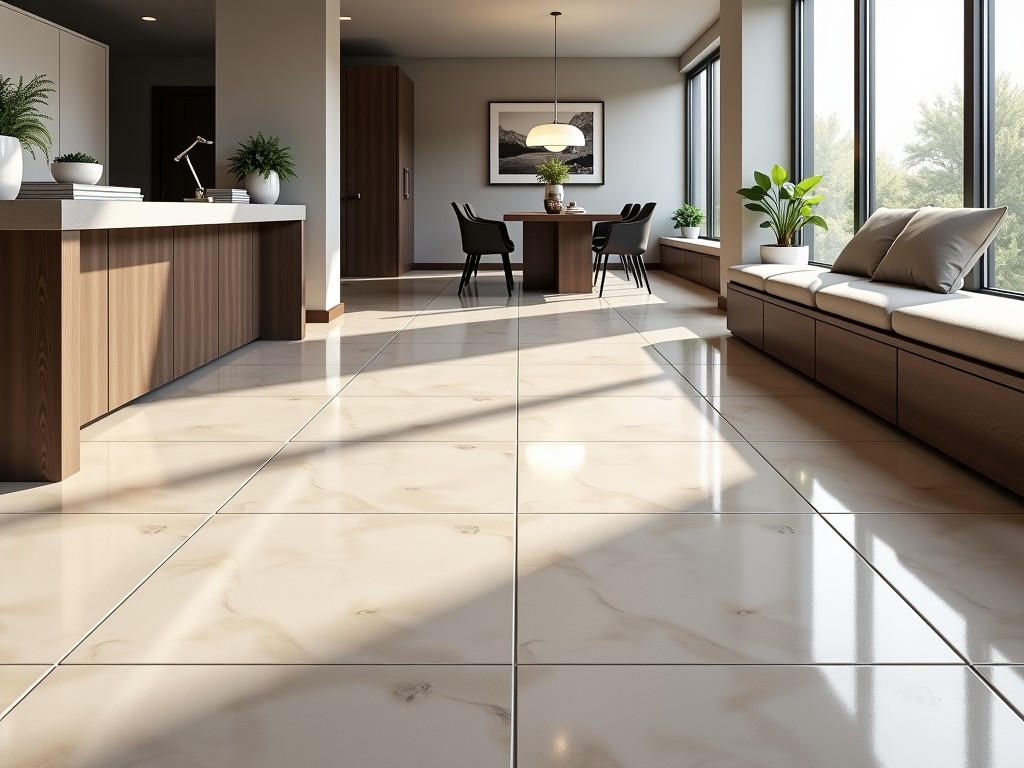
Porcelain tile is a vitrified ceramic product formed from refined clay, feldspar, and silica, pressed under high pressure and fired at temperatures exceeding 1200 °C. This process yields a dense, low‑porosity body with water absorption typically below 0.5 %, which underpins its suitability for high‑traffic commercial environments where moisture resistance and wear performance are critical.
The body consists of approximately 50 % kaolin clay, 25 % feldspar, and 25 % silica, with minor additives for color and flux control. After wet grinding and homogenization, the slip is spray‑dried to a granular powder, then pressed in hydraulic presses at 30–40 MPa to achieve green density. Firing in roller‑kiln furnaces creates a fully vitrified matrix, resulting in a homogeneous microstructure free of visible pores.
| Property | Typical Value | Test Standard |
|---|---|---|
| Nominal Size | 300 × 300 mm, 600 × 600 mm, 600 × 1200 mm (customizable) | ISO 10545‑2 |
| Thickness | 8 mm – 12 mm (depending on format) | ISO 10545‑2 |
| Water Absorption | ≤0.5 % | ISO 10545‑3 |
| PEI Wear Resistance | PEI IV (suitable for moderate to heavy traffic) | ISO 10545‑7 |
| Slip Resistance (R value) | R9 – R13 (surface finish dependent) | DIN 51130 / ASTM E303 |
| Modulus of Rupture | ≥35 MPa | ISO 10545‑4 |
| Breaking Strength | ≥1300 N | ISO 10545‑4 |
| Frost Resistance | Pass (no cracking after 100 freeze‑thaw cycles) | ISO 10545‑12 |
| Chemical Resistance | Class GA (resistant to household chemicals and swimming pool salts) | ISO 10545‑13 |
The low water absorption and high abrasion resistance make porcelain tile ideal for areas subjected to frequent wet cleaning, such as hotel lobbies, restaurant dining rooms, and hospital corridors. Its inert surface does not harbor microbes, supporting hygiene requirements in food preparation zones and laboratories. In transportation hubs like airports and train stations, the material’s resistance to rolling loads and impact from luggage carts ensures long service life with minimal maintenance.
Retail environments benefit from the tile’s ability to maintain visual consistency under constant foot traffic, while its compatibility with radiant heating systems allows seamless integration in showrooms and exhibition spaces. Educational institutions select porcelain for its resistance to staining from inks, paints, and laboratory reagents, preserving aesthetic integrity over decades of use.
Raw material lots are screened for particle size distribution and chemical composition before blending. During pressing, green density is monitored via laser displacement sensors to detect variations exceeding 0.5 %. Post‑firing, each tile undergoes dimensional inspection (length, width, thickness) using automated vision systems, with tolerances held to ±0.5 % of nominal size. Surface flatness is assessed with a straightedge and feeler gauge, ensuring warpage stays below 0.5 % of diagonal length. Slip resistance is measured on a pendulum tester for each finish batch, and results are documented for traceability.
Mechanical properties such as modulus of rupture and breaking strength are verified on a representative sample per lot according to ISO 10545‑4. Chemical resistance is checked by immersing tiles in standardized solutions and observing surface alteration after 24 hours. All test records are retained for a minimum of five years and are available to customers upon request.
Eliminating intermediaries reduces lead time because production scheduling is coordinated directly with the customer’s project timeline. Cost savings arise from avoided distributor margins and consolidated logistics, allowing larger volumes to be shipped in full‑container loads. Technical support is provided by the same engineers who oversee formulation and firing, facilitating rapid response to design changes or site‑specific performance questions.
Customers receive detailed product data sheets, installation guidelines, and maintenance recommendations directly from the manufacturer, ensuring that the information reflects the exact product supplied. This transparency reduces uncertainty during specification and helps prevent costly rework on site.
For project‑specific specifications, sample requests, or a formal quotation, reach out to our technical team.
Request a QuoteNational patents
Vinyl flooring line
K+ SQ.M capacity
Founded