46
National patents
Manufacturers produce interface commercial carpet tiles as modular flooring units designed for high‑traffic environments such as offices, healthcare facilities, and educational institutions. The
Order this product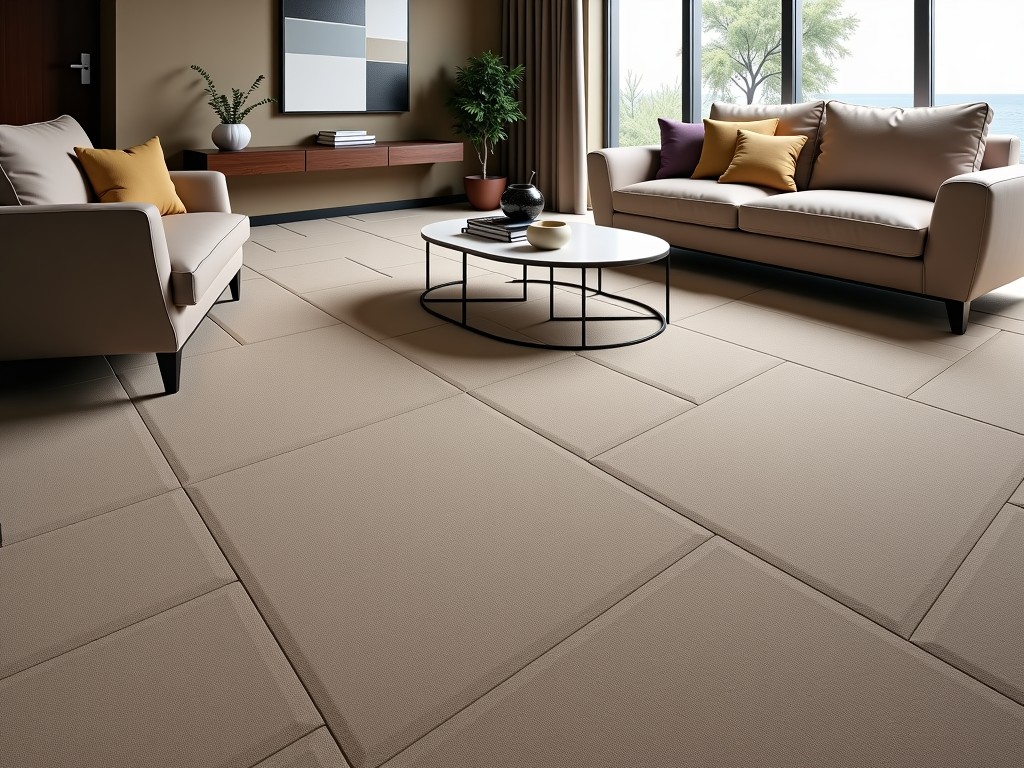
Manufacturers produce interface commercial carpet tiles as modular flooring units designed for high‑traffic environments such as offices, healthcare facilities, and educational institutions. The tiles feature a low‑profile backing that allows seamless integration with raised access floors, enabling easy removal and replacement without disrupting the underlying infrastructure. Buying factory direct eliminates intermediary markups, providing transparency in material sourcing and lead‑time commitments.
Specifically, the term “interface” refers to the tile’s engineered edge system that aligns with standard access floor panels, ensuring a flush surface and maintaining structural integrity of the floor grid. This design reduces installation time by allowing tiles to be snapped into place rather than glued, which also facilitates future reconfiguration of workspace layouts.
In a direct‑supply model, the manufacturer controls raw material selection, tufting density, and backing formulation, which translates into consistent performance across large orders. This control also enables tighter tolerances on dimensional stability, a critical factor when tiles must match the precise grid of an access floor system.
Typical values for key parameters are presented below; actual figures can be adjusted according to project requirements such as load expectations, aesthetic preferences, or acoustic targets.
| Parameter | Typical Range | Notes |
|---|---|---|
| Tile size (mm) | 500 × 500 | Standard module; other sizes available on request |
| Overall thickness (mm) | 6.0 – 8.0 | Includes wear layer and backing |
| Wear layer thickness (mm) | 0.5 – 0.8 | Determines abrasion resistance |
| Backing type | PVC‑coated polyester | Provides dimensional stability and moisture resistance |
| Tuft density (tufts/m²) | 180 000 – 220 000 | Higher density improves wear performance |
| Static load limit (kPa) | ≥ 5 | Suitable for office chair casters |
The face yarn is typically solution‑dyed nylon or polypropylene, offering inherent stain resistance and colorfastness under UV exposure. Solution dyeing locks pigment within the polymer matrix, preventing fading even when tiles are subjected to prolonged sunlight near windows or skylights.
A primary backing of non‑woven polyester provides the substrate for tufting, while a secondary PVC‑coated polyester layer adds rigidity and acts as a moisture barrier. This dual‑backing construction minimizes curling and ensures the tile remains flat when installed over access floor pedestals.
Edge interlocking features are molded into the backing during the coating process, creating a male‑female profile that engages with adjacent tiles and the access floor grid. Tolerances on these interlocks are held to ±0.1 mm to guarantee a tight fit without excessive force.
Abrasion resistance is measured via the Taber test, with typical values ranging from 300 mg to 500 mg loss after 1000 cycles under a 500 g load. This performance level satisfies commercial classifications for moderate to heavy foot traffic.
Impact sound reduction, expressed as ΔLw, generally falls between 15 dB and 22 dB when installed over a standard access floor system, contributing to acoustic comfort in open‑plan offices.
Thermal conductivity of the tile assembly is approximately 0.14 W/(m·K), which helps maintain stable floor temperatures when integrated with underfloor heating or cooling systems.
These tiles are chosen for environments where frequent reconfiguration of workspaces is required, such as technology hubs and consultancy firms. The ability to lift and replace individual tiles without damaging the floor grid reduces downtime during layout changes.
In each case, the product’s modular nature supports sustainable practices by allowing selective replacement rather than full‑floor refurbishment, thereby reducing material waste over the building’s life cycle.
Clients may specify alternative yarn compositions, such as recycled PET fibers, to meet corporate sustainability targets. The tufting gauge can be adjusted to alter pile height, influencing both tactile feel and acoustic performance.
Color matching is available through a digital spectrophotometer, enabling precise alignment with corporate branding palettes. Custom logos or patterns can be incorporated via jet‑printing on the wear layer before tufting.
Edge profiles can be tailored to non‑standard access floor modules, with tooling adjustments accommodated within the manufacturer’s production schedule.
Each batch undergoes dimensional inspection using laser scanners to verify tile size and edge interlock conformity. Statistical process control charts monitor tuft density and backing thickness to detect deviations before shipment.
Abrasion and static load tests are performed on random samples per lot, with results logged against internal benchmarks. Documentation of these tests is provided upon request, supporting traceability for project audits.
Packaging includes corrugated cartons with edge protectors and moisture‑barrier liners, designed to safeguard tiles during transit and storage on‑site.
Can dimensions be customized? Yes, tile size and thickness can be adjusted according to project specifications; tooling changes are discussed during the quotation phase.
What information is required before quotation? Required details include desired tile dimensions, wear layer thickness, backing type, color or pattern preferences, and estimated order quantity.
How is quality inspected? Every lot undergoes dimensional scanning, tuft density verification, and abrasion testing; test reports are available for review.
What packaging methods are available? Standard packaging uses double‑wall cartons with corner guards; optional palletizing with stretch‑wrap is offered for large volumes.
What is the typical production lead time? Lead time ranges from 4 to 6 weeks after approval of samples, depending on complexity of customizations.
For further details, technical data sheets, or to arrange a sample shipment, please contact our sales team.
Contact UsNational patents
Vinyl flooring line
K+ SQ.M capacity
Founded