46
National patents
This flooring system is engineered for environments where continuous pedestrian flow exceeds 5,000 persons per day. It combines a wear-resistant polyvinyl chloride (PVC) surface layer with a
Order this product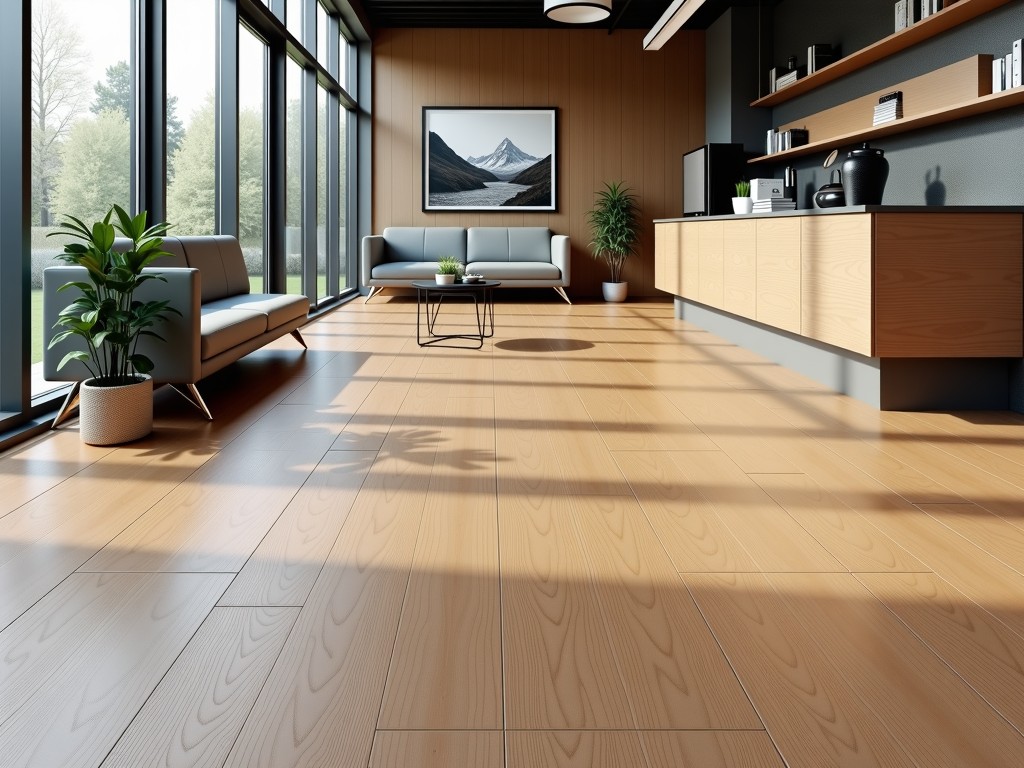
This flooring system is engineered for environments where continuous pedestrian flow exceeds 5,000 persons per day. It combines a wear-resistant polyvinyl chloride (PVC) surface layer with a reinforced foam backing to distribute point loads and reduce impact noise.
| Property | Typical Value | Test Standard |
|---|---|---|
| Wear layer thickness | 0.55 mm | EN 649 |
| Total thickness | 2.0 mm | EN 428 |
| Abrasion resistance (weight loss) | ≤ 0.08 g/1000 cycles | EN 660-2 |
| Slip resistance (CoF) | ≥ 0.45 (wet) | EN 13893 |
| Impact sound reduction | 17 dB | EN ISO 140-8 |
| Static load limit | 2.5 kN per castor wheel (ISO 22882) | ISO 22882 |
The wear layer is a calendared PVC film containing aluminum oxide particles for enhanced abrasion resistance. Beneath it, a printed design layer provides visual options without compromising durability. The backing consists of a closed‑cell foam reinforced with a polyester scrim, which delivers dimensional stability and contributes to acoustic performance.
Retail environments experience consistent appearance under constant trolley traffic and frequent cleaning cycles. In educational institutions, the slip‑resistant surface reduces fall risk while the acoustic backing lowers hallway noise levels. Healthcare facilities utilize the seamless welding capability, which eliminates crevices that could harbor pathogens and supports infection‑control protocols.
Subfloors must be flat to within 3 mm over a 2 m radius and free of moisture exceeding 2% relative humidity (ASTM F2170). A pressure‑sensitive adhesive compatible with PVC is recommended; open time should not exceed 20 minutes to ensure proper bonding. Seams are heat‑welded using a 2 mm welding rod, producing a continuous surface that meets EN ISO 105‑B02 for colour fastness.
Routine maintenance involves neutral pH cleaners applied with a microfiber mop; abrasive pads should be avoided to preserve the wear layer. Under typical commercial footfall, the product retains ≥ 80% of its original gloss after 7 years, corresponding to a wear rate of less than 0.03 mm per year. Periodic recoating is not required due to the inherent UV stabilizers in the PVC film.
Each production line incorporates inline laser thickness gauges that reject material deviating beyond ±0.02 mm from target. Finished rolls are sampled for abrasion resistance per EN 660-2; batches failing to meet the ≤0.08 g/1000 cycles criterion are quarantined. Additionally, a random 10% of rolls undergo slip‑resistance testing under both dry and wet conditions to verify the ≥0.45 coefficient of friction.
| Option | Available Range | Lead Time Impact |
|---|---|---|
| Wear layer thickness | 0.30 – 0.70 mm | None (standard) |
| Total thickness | 1.5 – 3.0 mm | +2 days for >2.5 mm |
| Custom color (Pantone) | Customer‑provided reference | +5 days |
| Emboss pattern | Wood, stone, abstract | None |
Can dimensions be customized? Yes, rolls can be slit to widths between 0.5 m and 2.0 m, and lengths can be cut to project‑specific requirements.
What information is required before quotation? Required data include total area, desired wear layer thickness, finish type, and any custom color or emboss pattern.
How is quality inspected? Inline thickness monitoring, abrasion resistance sampling, and slip‑resistance verification are performed on every batch as described in the quality control section.
What packaging methods are available? Rolls are wrapped in polyethylene film, placed on cardboard cores, and loaded onto pallets with edge protectors; export shipments include moisture‑barrier bags and corner braces.
For technical datasheets, sample requests, or a project‑specific quotation, please contact our engineering team.
Request Quote or SampleNational patents
Vinyl flooring line
K+ SQ.M capacity
Founded