46
National patents
Industrial flooring tiles are engineered as modular units that combine a dense polymer‑based core with a wear‑resistant surface layer, allowing rapid installation over concrete substrates while
Order this product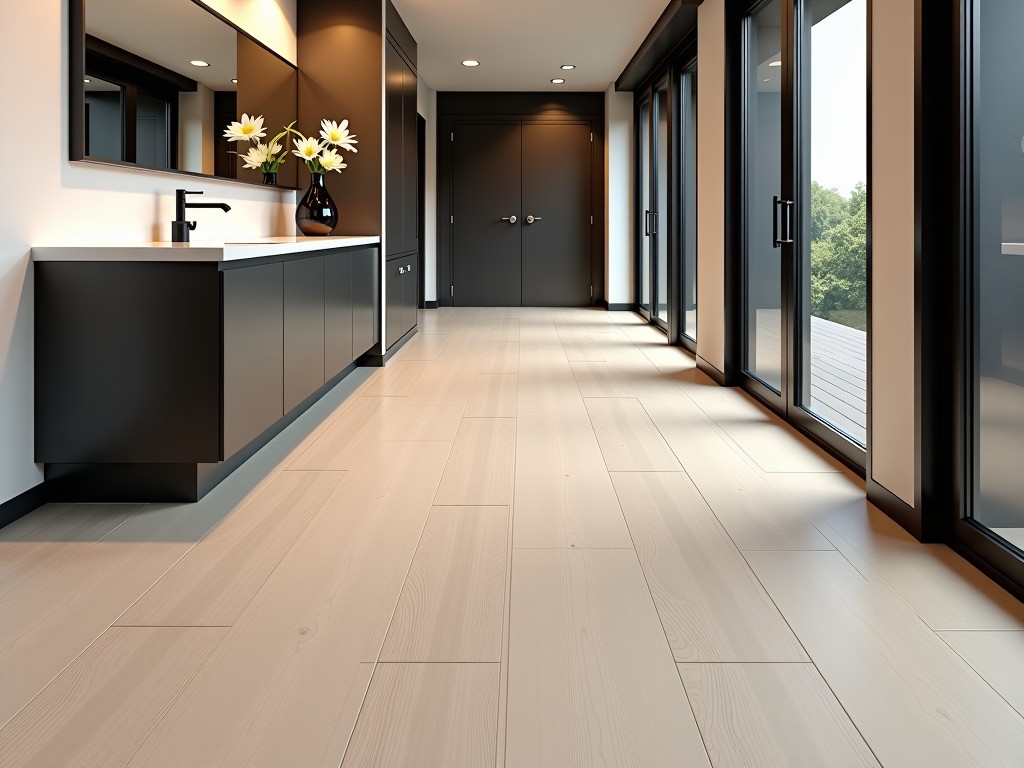
Industrial flooring tiles are engineered as modular units that combine a dense polymer‑based core with a wear‑resistant surface layer, allowing rapid installation over concrete substrates while distributing point loads across a wide area.
Typical thicknesses range from 6 mm to 12 mm, with nominal dimensions of 300 mm × 300 mm or 600 mm × 600 mm, enabling designers to match module size to traffic patterns and equipment wheel bases.
The core formulation incorporates recycled calcium carbonate fillers and impact modifiers, which improve compressive strength without adding excessive weight to the flooring system.
The wear layer consists of a UV‑stabilized polyvinyl chloride (PVC) blend reinforced with aluminum oxide granules, achieving a hardness rating of 80 Shore A and providing resistance to abrasion from pallet jack wheels.
During production, the core and wear layers are co‑extruded under controlled temperature profiles, then cut to size and subjected to a post‑curing cycle that reduces internal stresses and enhances dimensional stability.
Additives such as anti‑static agents and antimicrobial compounds can be incorporated into the melt stream upon request, tailoring the tile to environments where electrostatic discharge or microbial growth is a concern.
| Property | Typical Value | Test Standard |
|---|---|---|
| Compressive Strength | ≥ 25 MPa | ASTM C109 |
| Abrasion Resistance (Taber) | ≤ 0.02 g loss per 1000 cycles | ASTM D4060 |
| Slip Resistance (R‑value) | R10 (wet) | DIN 51130 |
| Water Absorption | ≤ 0.5 % | ISO 10545‑3 |
| Thermal Expansion Coefficient | 5 × 10⁻⁵ / °C | ASTM D696 |
These values represent typical results from production‑line testing; actual performance may vary based on specific formulation adjustments and installation conditions.
Engineers use the abrasion and slip data to predict service life in high‑traffic zones such as loading docks, while the low water absorption supports use in areas exposed to frequent cleaning or occasional spills.
Tiles are typically adhered to a primed concrete substrate using a thin‑set epoxy or polyurethane adhesive, applied with a notched trowel to achieve a uniform thickness of 1.5 mm.
Joint widths of 2 mm to 3 mm are maintained with flexible PVC spacers, allowing for thermal movement and preventing edge chipping under dynamic loads.
After placement, the floor is rolled with a 50 kg steel roller to ensure full contact, then cured for 24 hours at 20 °C before light traffic is permitted; full chemical resistance develops after 7 days.
In manufacturing facilities, the tile’s high compressive strength supports the static weight of heavy machinery and the impact loads from dropped tools, reducing the risk of substrate cracking.
Warehouse environments benefit from the low water absorption and chemical resistance, which protect the floor from oil, solvents, and cleaning agents commonly used in inventory handling.
Retail showrooms and automotive service centers select the slip‑resistant surface (R10) to maintain safety for both employees and customers while allowing easy maintenance with standard floor‑scrubbing equipment.
Custom specifications are evaluated during the quotation phase to confirm tooling feasibility and lead‑time implications.
Each production batch undergoes inline monitoring of melt pressure and extrusion temperature, with statistical process control charts tracking deviations beyond ±2 % of target values.
Finished tiles are sampled for dimensional accuracy (±0.1 mm), wear‑layer hardness, and adhesion strength; results are logged and compared against internal acceptance criteria before release.
Compliance documentation, including ISO 9001 certification and test reports per ASTM and DIN standards, is available upon request for project qualification dossiers.
Tiles are stacked in layers separated by recyclable polyethylene sheets, then placed on Euro‑pallets (800 mm × 1200 mm) with a maximum load of 1 tonne per pallet to ensure stability during transit.
Each pallet is stretch‑wrapped and fitted with corner protectors; pallets are labeled with batch codes, product codes, and handling instructions (e.g., “Keep Dry”, “Do Not Stack >2”).
For full container loads, pallets are arranged in a interlocking pattern to minimize shifting, and a moisture‑absorbing desiccant packet is included per container to safeguard against humidity‑related degradation during long‑haul shipments.
Additional technical inquiries can be directed to our application engineering team.
To receive a detailed proposal, please provide your project specifications, required quantities, and preferred delivery schedule.
Submit your inquiry through our contact form to initiate the quotation process.
National patents
Vinyl flooring line
K+ SQ.M capacity
Founded