46
National patents
This page details the technical characteristics of rubber flooring systems designed for high‑traffic commercial kitchen environments. Information is presented to assist procurement managers, facility
Order this product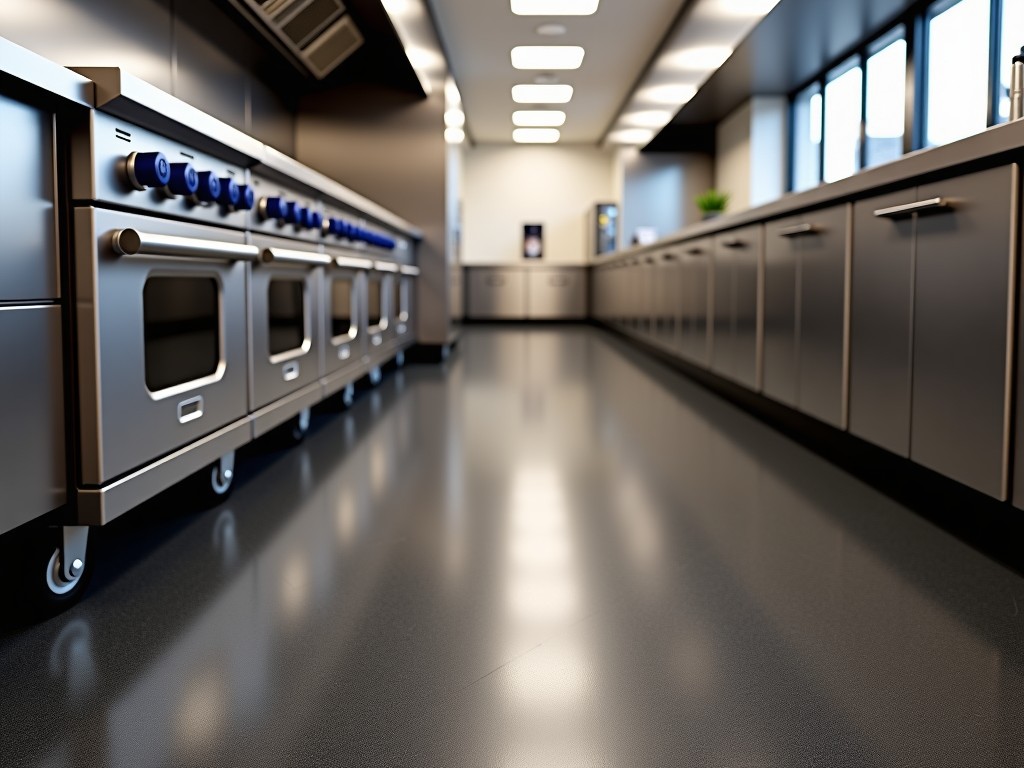
This page details the technical characteristics of rubber flooring systems designed for high‑traffic commercial kitchen environments. Information is presented to assist procurement managers, facility engineers, and distributors in evaluating suitability based on measurable performance criteria.
The flooring consists of a vulcanized rubber matrix blended with recycled tire granules and reinforcing fillers. Typical rubber content ranges from 65 % to 75 % by weight, providing elasticity while maintaining dimensional stability under repeated thermal cycling.
A wear‑resistant top layer incorporates a nitrile‑modified surface that resists oil, grease, and common kitchen chemicals. The backing layer features a closed‑cell foam core that reduces impact noise and offers thermal insulation, with a measured density of 0.55 g/cm³ ±0.05.
| Property | Typical Value | Test Method |
|---|---|---|
| Thickness | 6 mm to 12 mm (customizable) | ASTM F386 |
| Durometer Hardness (Shore A) | 70 ± 5 | ASTM D2240 |
| Coefficient of Friction (wet) | ≥0.60 | ASTM C1028 |
| Tensile Strength | ≥2.5 MPa | ASTM D412 |
| Temperature Resistance | -20 °C to +80 °C | Internal cycling test |
| Fire Rating | Class Bfl‑s1 (EN 13501‑1) | EN ISO 9239‑1 |
The product is supplied in interlocking tiles or sheet rolls with a factory‑applied pressure‑sensitive adhesive backing. Substrate preparation requires a clean, level concrete surface with a maximum moisture vapor emission rate of 3 lb/1000 ft²/24 hr as measured by ASTM F1869.
Tiles are installed using a floating method; mechanical fastening is not required. Expansion gaps of 3 mm per linear meter are recommended to accommodate thermal movement. Seams are sealed with a compatible polyurethane sealant to maintain chemical resistance.
Thickness, surface pattern, and edge profiling can be adjusted to match specific load requirements and design preferences. Color matching to corporate palettes is achievable through pigment incorporation during compounding, with a standard tolerance of ±5 % ΔE.
Optional antimicrobial additives (silver‑ion based) are available upon request, providing a measured reduction of surface bacteria >99 % after 24 hr exposure per JIS Z 2801.
Each batch undergoes inline rheometry to verify cure characteristics, followed by post‑cure testing of hardness, tensile strength, and compression set. Finished products are inspected for dimensional tolerances using laser scanning, with acceptance criteria of ±0.2 mm on thickness and ±0.5 % on length/width.
Random samples are subjected to accelerated aging (UV‑B 0.68 W/m², 50 °C, 500 hr) to evaluate long‑term property retention. Results are documented in a traceable test report linked to the production lot number.
Q: Can the flooring be cut to fit irregular kitchen layouts?
A: Yes. Both tile and roll formats can be trimmed on‑site using a utility knife or rotary cutter; sealed edges maintain chemical resistance.
Q: What information is required to obtain a quotation?
A: Project area (square meters), desired thickness, surface pattern, any custom color or antimicrobial additive, and preferred delivery timeline.
Q: How is quality verified before shipment?
A: Each lot receives a final inspection report covering hardness, thickness, and visual defects; reports are available upon request.
For further technical data, sample requests, or to discuss project‑specific requirements, please contact our sales engineering team.
Request a QuoteNational patents
Vinyl flooring line
K+ SQ.M capacity
Founded