46
National patents
LVT rigid click flooring consists of a printed vinyl wear layer bonded to a dense core board that features a milled tongue‑and‑groove profile. The core typically contains calcium carbonate filler and
Order this product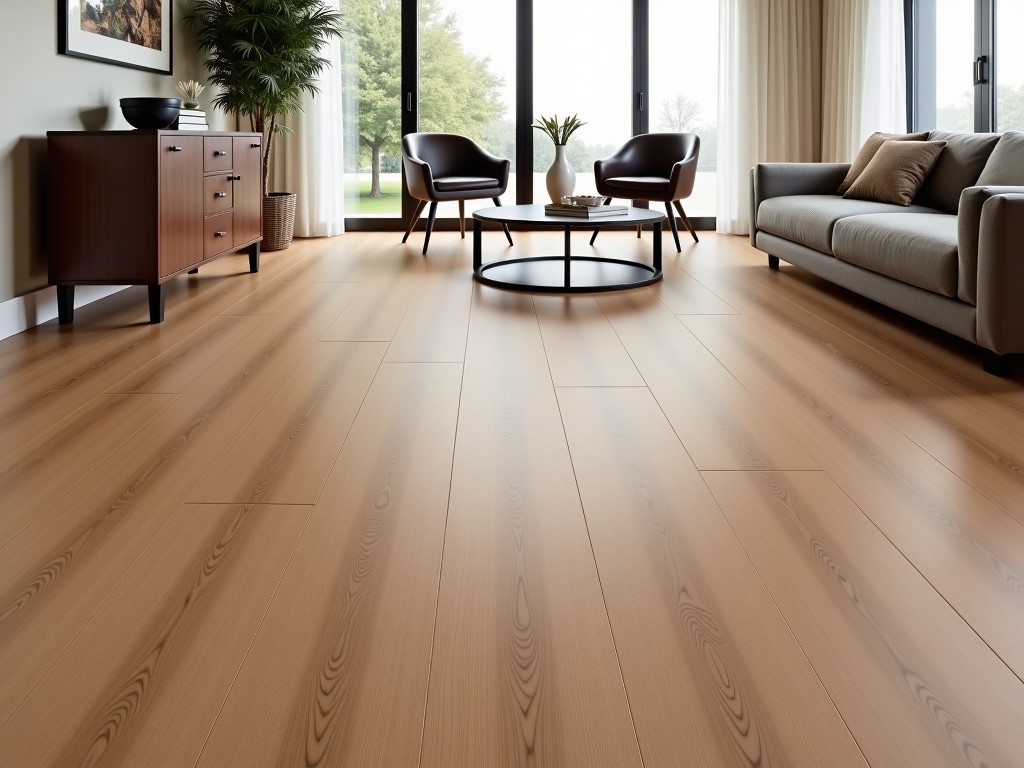
LVT rigid click flooring consists of a printed vinyl wear layer bonded to a dense core board that features a milled tongue‑and‑groove profile. The core typically contains calcium carbonate filler and polypropylene resin, giving the panel high flexural modulus and low thermal expansion. This structure enables the flooring to stay flat over subfloors with minor irregularities and to be installed without adhesives.
Because the locking system relies on mechanical interlock, installation time is reduced compared with glue‑down methods, and the floor can be lifted and re‑laid if needed for access to utilities.
| Property | Typical Value | Notes |
|---|---|---|
| Overall Thickness | 4.0 mm – 6.5 mm | Core + wear layer |
| Wear Layer Thickness | 0.3 mm – 0.7 mm | Measured in mils (12–28 mil) |
| Plank Width | 100 mm – 250 mm | Customizable per project |
| Plank Length | 900 mm – 1800 mm | Standard lengths; custom cuts available |
| Locking System | Uniclic‑type tongue‑groove | No adhesive required |
| Static Load Resistance | ≥ 150 N/mm² | ASTM F970 |
The flooring is laid floating over a clean, level subfloor. An underlayment of 1‑2 mm polyethylene foam is recommended to accommodate minor surface variations and to provide sound insulation. Planks are angled into the groove of the preceding row and pressed down until the lock engages. No curing time is required, allowing immediate foot traffic.
Expansion gaps of 8‑10 mm are left around the perimeter and at fixed objects to accommodate seasonal movement. Transition strips are used where the flooring meets other floor types or at doorways.
Each production lot undergoes inline thickness gauging and wear‑layer abrasion testing according to EN 649 standards. Visual inspection checks for pattern registration, embossing consistency, and edge straightness. Samples are submitted for accelerated aging (UV exposure 150 h) to verify colour stability.
Final packaging includes corner protectors and stretch‑film wrapping to prevent edge damage during transit. Moisture barrier bags are added for shipments to high‑humidity regions.
Yes. Width, length, and thickness can be adjusted according to project specifications. Minimum order quantities apply for non‑standard sizes.
Required details include total area, desired wear‑layer thickness, preferred finish, any special core density, and delivery destination.
In‑line gauging, abrasion tests (EN 649‑2), visual checks for pattern alignment, and post‑production UV ageing tests are performed on each batch.
Standard packaging uses corrugated cartons with corner protectors and stretch‑film. For export, moisture‑barrier bags and palletizing with strapping are offered.
Lead time ranges from 2‑4 weeks for stocked specifications and 4‑6 weeks for customized orders, depending on quantity and destination.
For detailed specifications, sample requests, or project‑specific pricing, please reach out to our technical sales team.
National patents
Vinyl flooring line
K+ SQ.M capacity
Founded