46
National patents
This product consists of a layered PVC composite where a printed design layer is bonded to a reinforced backing and topped with a transparent wear layer. The structure provides visual diversity while
Order this product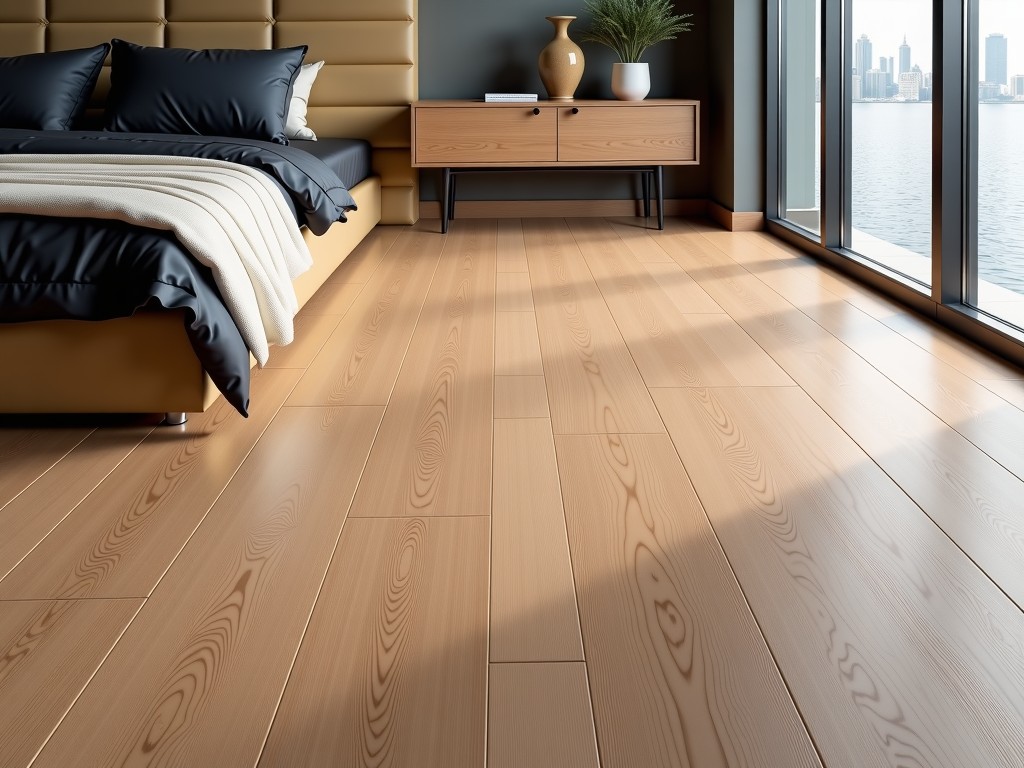
This product consists of a layered PVC composite where a printed design layer is bonded to a reinforced backing and topped with a transparent wear layer. The structure provides visual diversity while maintaining dimensional stability under varying load conditions.
The typical build‑up includes a 0.30 mm PVC foam backing for impact absorption, a 0.10 mm glass‑fiber reinforced stabilization layer, a high‑definition printed film, and a 0.30 mm pure PVC wear layer. Additives such as plasticizers, stabilizers, and UV absorbers are incorporated to meet specific performance targets.
Total thickness ranges from 2.0 mm to 3.0 mm depending on the wear‑layer specification, while the overall weight varies between 2 kg/m² and 2.8 kg/m². The backing is engineered to resist curling when exposed to temperature fluctuations common in industrial environments.
| Property | Typical Value | Test Standard |
|---|---|---|
| Wear Resistance (mm loss after 1000 cycles) | ≤0.05 | ISO 10582 |
| Dimensional Stability (% change after 6 h at 80 °C) | ≤0.15 | EN 434 |
| Fire Classification | Bfl‑s1 | EN 13501‑1 |
| Slip Resistance (R value) | R10 (wet) | DIN 51130 |
| Static Load Limit (psi) | 150 | ASTM F970 |
These values are representative of standard production lots; actual figures can be adjusted by modifying wear‑layer thickness or backing density to suit specific load‑bearing or safety requirements.
In each setting, the flooring’s ability to maintain flatness under cyclic loading and its resistance to staining agents reduce maintenance intervals and extend service life compared with homogeneous vinyl or rubber alternatives.
The product is supplied in rolls typically 2 m wide and up to 30 m long. Installation requires a smooth, dry substrate with moisture content below 2 % as measured by a calcium chloride test. A pressure‑sensitive adhesive compatible with PVC is recommended; full spread application ensures optimal bonding and prevents edge lifting.
Seams are cold‑welded using a PVC solvent that matches the wear layer chemistry, producing a continuous surface that prevents ingress of liquids. Expansion gaps of 5 mm per 10 m length are accommodated by perimeter trimming to allow for thermal movement.
Each production batch undergoes inline thickness monitoring via laser gauging, with tolerances held to ±0.05 mm. Visual inspection of the printed layer is performed under standardized lighting to detect color deviation beyond ΔE 2.0. Wear layer hardness is checked using a Shore D durometer, targeting a range of 85‑90.
Finished rolls are subjected to accelerated aging (UV exposure 150 h, humidity 80 % RH) to verify stability of color and mechanical properties. Results are documented in a test report available upon request.
Customization is managed through a formal specification sheet that defines target performance metrics, allowing the engineering team to adjust formulation and processing parameters accordingly.
Rolls are wrapped in polyethylene film, placed on corrugated pallets, and secured with poly‑strap. Each pallet carries a maximum of 4 rolls, total weight not exceeding 1 tonne to conform with standard container loading limits. Labels include product code, batch number, dimensions, and handling instructions.
For overseas shipments, containerized cargo is protected with moisture‑barrier bags and shock‑absorbing corner boards. Delivery lead times are typically 3‑4 weeks after receipt of a signed purchase order, subject to destination port clearance.
To discuss technical specifications, obtain a sample, or request a formal quote, please contact our engineering team via the link below.
Submit InquiryNational patents
Vinyl flooring line
K+ SQ.M capacity
Founded