46
National patents
The product consists of a multi‑layer luxury vinyl tile where a photographic film replicates the look of square ceramic or stone tiles, complete with grout‑line visuals. A clear wear layer protects
Order this product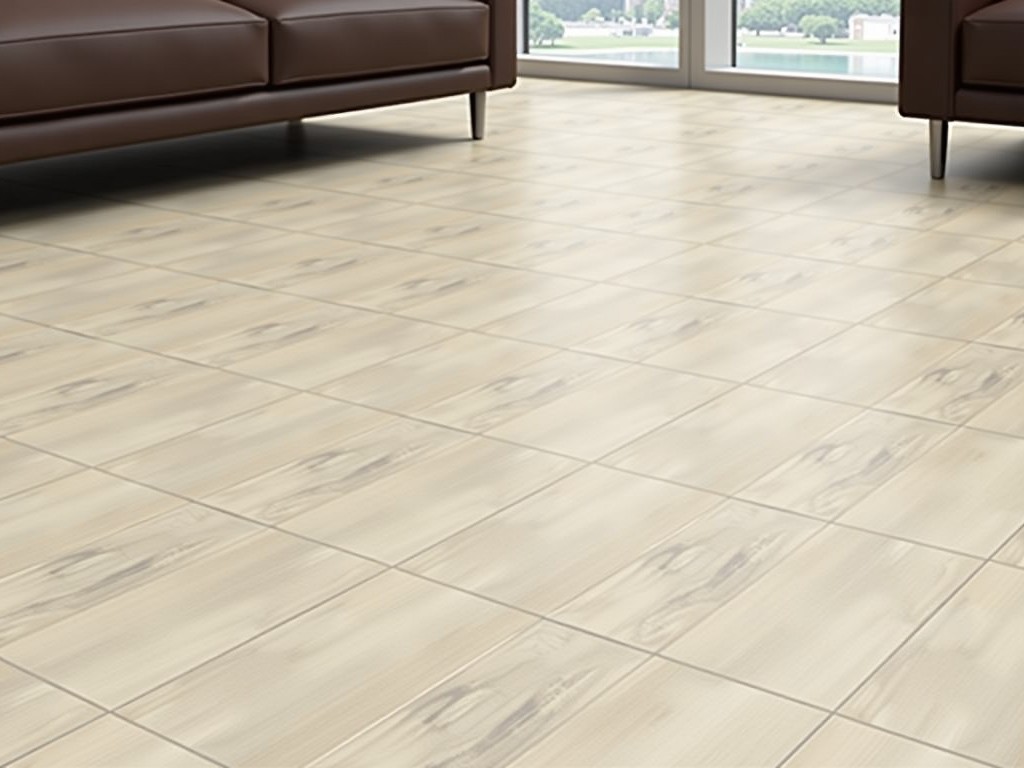
The product consists of a multi‑layer luxury vinyl tile where a photographic film replicates the look of square ceramic or stone tiles, complete with grout‑line visuals. A clear wear layer protects the surface, while a rigid PVC core provides dimensional stability. This construction enables the flooring to mimic tile aesthetics without the weight, brittleness, or installation complexity of genuine tile.
Designers and engineers evaluate LVT flooring by comparing measurable performance attributes that directly affect service life and maintenance cost. The following table lists typical ranges for key properties, which can be adjusted according to project specifications.
| Property | Typical Value | Test Standard |
|---|---|---|
| Total Thickness | 2.0 mm – 3.0 mm (customizable) | ASTM F1700 |
| Wear Layer Thickness | 0.3 mm – 0.7 mm | ASTM F410 |
| Abrasion Resistance | ≤ 0.02 g loss per 1000 cycles | ASTM D4060 |
| Indentation Resistance | ≤ 0.05 mm after 75 kg load | ASTM F1914 |
| Dimensional Stability (80 °C, 8 h) | ≤ 0.15 % change | ASTM F2199 |
| Slip Resistance (Pendulum) | Dry ≥ 0.6, Wet ≥ 0.45 | ASTM E303 |
These values influence slip safety, resistance to surface wear, and dimensional change under temperature fluctuations, allowing specifiers to match the flooring to the expected traffic and environmental conditions.
Because each project may require a unique module size, visual pattern, or edge treatment, the supplier offers a range of adjustable parameters that are defined during the quotation stage.
In environments where flooring must endure frequent cleaning, occasional impact, and visual continuity, the square‑tile look provides both functional and design advantages.
Quality assurance is built into every production batch through standardized testing and statistical process control, ensuring that each shipment meets the agreed‑upon specifications.
Proper packaging protects the printed surface and edges during transit, preserving product integrity until installation.
Yes. Custom lengths and widths up to 600 mm × 600 mm are available in 10 mm increments, subject to tooling constraints.
Required details include desired tile size, wear‑layer thickness, pattern or color reference, edge treatment, backing preference, estimated quantity, and delivery destination.
For light‑traffic areas such as offices or boutiques, 0.3 mm to 0.4 mm suffices. Moderate traffic (schools, corridors) benefits from 0.5 mm. Heavy‑traffic zones (hospitals, retail) should use 0.6 mm to 0.7 mm.
Slip resistance is tested using the pendulum method (ASTM E303) on both dry and wet surfaces. Results are reported as slip‑resistance values (SRV) and compared against safety thresholds for the intended environment.
Tiles are stacked with polyethylene film separators, placed in cardboard sleeves, palletized, stretch‑wrapped, and strapped. Each pallet is labeled with handling instructions and batch information for traceability.
Lead time generally ranges from 4 to 6 weeks, depending on order complexity, customization level, and current production schedule.
Yes. Samples are produced using the same specifications as the final order, cut to 100 mm × 100 mm pieces, and shipped with a protective film to prevent surface damage.
To discuss your project requirements and obtain a detailed quotation, please contact our technical sales team.
National patents
Vinyl flooring line
K+ SQ.M capacity
Founded