46
National patents
Sheet vinyl flooring is produced as a continuous roll, typically 2 mm to 5 mm thick, comprising a wear layer, printed design layer, and backing. When the design layer reproduces ceramic or stone tile
Order this product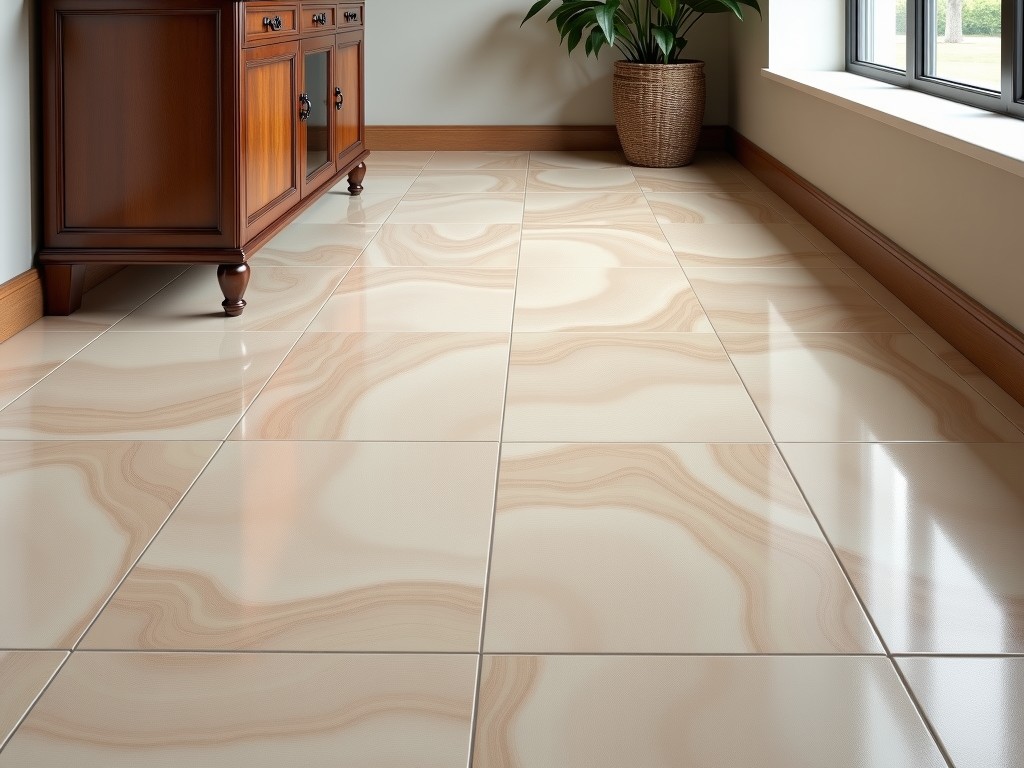
Sheet vinyl flooring is produced as a continuous roll, typically 2 mm to 5 mm thick, comprising a wear layer, printed design layer, and backing. When the design layer reproduces ceramic or stone tile patterns, the product delivers the visual aesthetic of tile while retaining vinyl’s resilience, moisture resistance, and installation flexibility.
Wear layers are generally clear polyurethane coatings ranging from 0.3 mm to 0.7 mm thick, which govern abrasion resistance measured in Taber cycles. For commercial settings, a wear layer of 0.5 mm or more commonly achieves a rating of 30,000+ cycles, suitable for moderate foot traffic.
High‑resolution rotogravure printing on a transparent film creates the tile image, which is then laminated under heat and pressure to the vinyl core. Print resolution of 300 dpi or higher ensures grout lines, texture variations, and color shading match real ceramic tiles within a ΔE<2 tolerance.
Embossing rollers can impart a surface texture that mimics glazed or unglazed tile, influencing both slip resistance and visual depth. Typical emboss depth ranges from 0.05 mm to 0.15 mm.
| Property | Typical Value | Test Standard |
|---|---|---|
| Overall thickness | 3.0 mm (standard) | ASTM F386 |
| Wear layer thickness | 0.5 mm | ASTM F410 |
| Abrasion resistance (Taber cycles) | 35,000 | ASTM D4060 |
| Slip resistance (R rating) | R10 | DIN 51130 |
| Fire rating | Bfl‑s1 | EN 13501‑1 |
| Dimensional stability (wet) | ≤0.15 % | ASTM F2199 |
The combination of vinyl durability with tile appearance makes the product suitable for environments where moisture exposure, chemical resistance, and ease of maintenance are critical.
Each production lot undergoes inline thickness gauging, wear layer adhesion testing (peel strength ≥1.5 N/mm), and color consistency checks using spectrophotometry (ΔE<1.5 between batches). Finished rolls are subjected to accelerated weathering (UV‑B 0.8 W/m² for 1000 h) to verify that the printed design does not exceed a ΔE of 3 after exposure.
Documentation includes a material safety data sheet (MSDS), ISO 9001 quality management certification, and, upon request, third‑party test reports for slip resistance and fire performance.
The vinyl core can be formulated with up to 30 % recycled content without compromising mechanical properties. Phthalate‑free plasticizers are available to meet REACH and RoHS requirements. At end‑of‑life, the product can be granulated for reuse in lower‑grade flooring or composite panels.
Custom sheet vinyl flooring is produced to order. Required inputs for quotation include: desired total area (m²), tile module size, wear layer thickness, backing type, and any special additives (e.g., antimicrobial, anti‑static). Standard production lead time is 3‑4 weeks after approval of the digital proof; expedited runs can be arranged for projects with critical schedules.
Samples are supplied as 300 mm × 300 mm printed panels with the selected wear layer and backing, allowing on‑site evaluation of color, texture, and slip characteristics.
To initiate a custom specification, provide project dimensions, performance requirements, and any regulatory constraints. Our engineering team will return a detailed quote, including material data sheet, layout recommendations, and installation guidelines.
Request QuoteNational patents
Vinyl flooring line
K+ SQ.M capacity
Founded