46
National patents
This product line consists of factory‑direct luxury vinyl tile (LVT) engineered for commercial interiors where foot traffic, moisture exposure, and maintenance frequency demand predictable
Order this product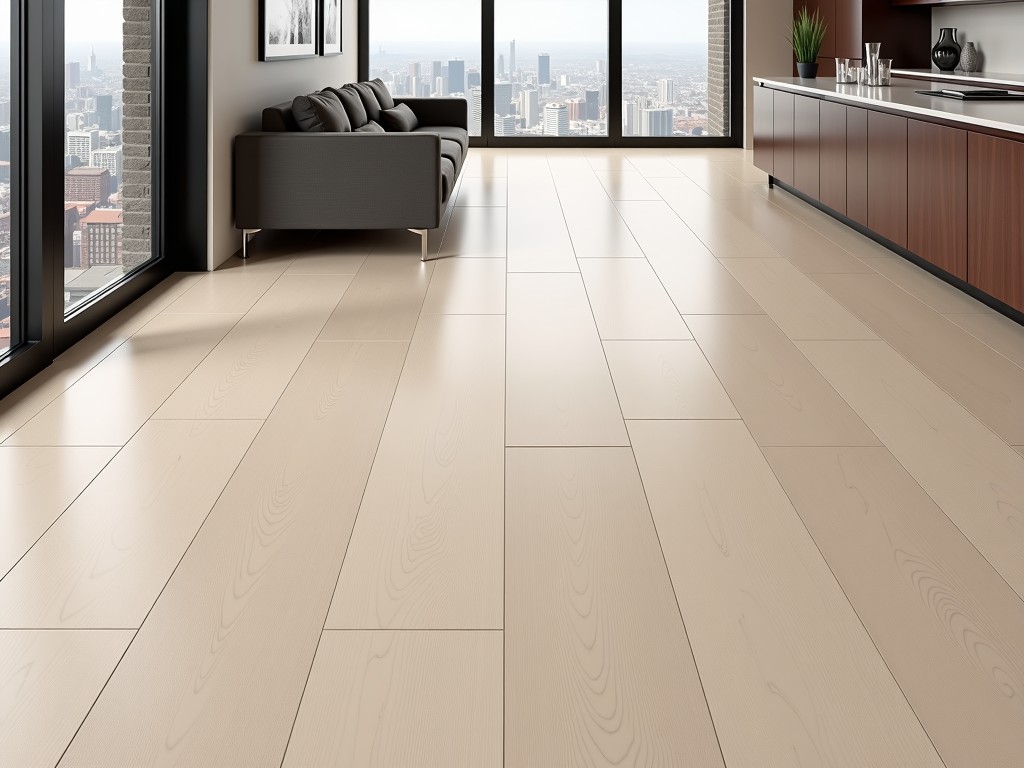
This product line consists of factory‑direct luxury vinyl tile (LVT) engineered for commercial interiors where foot traffic, moisture exposure, and maintenance frequency demand predictable performance. The construction follows a multi‑layer approach that separates decorative, wear‑resisting, and structural functions, allowing precise control over each property.
The topmost layer is a transparent wear layer made from polyvinyl chloride (PVC) reinforced with aluminum oxide particles, providing abrasion resistance measured in revolutions under Taber testing. Beneath it lies a high‑resolution photographic film that reproduces wood, stone, or abstract designs, printed with UV‑stable inks to prevent fading under typical indoor lighting (≤500 lux). The core is a rigid composite of calcium carbonate and PVC, formulated to achieve a specific gravity between 1.4 and 1.6, contributing to dimensional stability and impact resistance. A backing layer of PVC with added fiberglass scrim balances the assembly and reduces curling during temperature cycles.
Total thickness options range from 2.0 mm to 5.0 mm, with wear layer thicknesses available in 0.3 mm, 0.5 mm, and 0.7 mm variants. Edge profiles include square, beveled, and micro‑beveled finishes, each influencing joint visibility and cleaning ease. All layers are calendared under controlled temperature (≈160 °C) and pressure to ensure uniform bonding without voids or delamination points.
| Property | Typical Value | Test Method / Standard |
|---|---|---|
| Wear Layer Thickness | 0.3 mm – 0.7 mm | ASTM F410 |
| Total Thickness | 2.0 mm – 5.0 mm | ASTM F386 |
| Abrasion Resistance (Taber) | ≤150 mg loss (1000 cycles, CS‑10 wheel) | ASTM D4060 |
| Slip Resistance (R value) | R10 (wet) – R11 (dry) | DIN 51130 |
| Dimensional Stability (ΔL/L) | ≤0.15 % after 6 h at 80 °C/90 % RH | EN 434 |
| Static Load Resistance | ≥2000 psi (no delamination) | ASTM F970 |
| VOC Emissions | ≤0.5 mg/m³ (TVOC) | ISO 16000‑9 |
The wear layer thickness directly correlates with commercial service life; a 0.5 mm layer typically supports 10‑year warranty in moderate‑traffic offices, while 0.7 mm extends suitability to high‑traffic retail corridors. Slip resistance values meet the thresholds required for ADA‑compliant pathways when combined with appropriate surface texture.
The product is available in glue‑down and interlocking (click) formats. Glue‑down versions require a smooth, dry substrate with compressive strength ≥2 MPa; a pressure‑sensitive acrylic adhesive is applied at 200‑250 g/m² and cured per manufacturer’s open time. Interlocking tiles feature a milled tongue‑and‑groove system that locks at a 5‑degree angle, enabling floating installation over existing hard surfaces with an optional 1 mm acoustic underlayment.
Expansion gaps of 2 mm per linear meter are recommended at perimeter walls and fixed objects to accommodate thermal movement. Seams are sealed with a PVC‑based seam sealer where moisture barrier integrity is critical, such as in wet‑area bathrooms.
Each production lot undergoes inline thickness monitoring using laser gauges with ±0.01 mm tolerance. Wear layer adhesion is evaluated by peel testing per ASTM D903, targeting a minimum of 1.5 N/mm. After pressing, boards are conditioned at 23 °C/50 % RH for 48 hours before undergoing dimensional stability and slip resistance tests. Finished tiles are inspected visually for color deviation (ΔE < 2) and surface defects under 500 lux illumination.
Statistical process control charts track key parameters; any batch exceeding control limits triggers a hold and root‑cause analysis before release. Documentation includes material safety data sheets (MSDS), test certificates, and traceability labels linking each pallet to the specific extrusion run.
The core formulation incorporates up to 40 % calcium carbonate, a naturally abundant mineral, reducing reliance on virgin PVC. Recycling programs accept post‑consumer LVT for regrinding into new backing layers, supporting closed‑loop material flow. Manufacturing plants operate with closed‑loop water cooling and recover >85 % of process heat for auxiliary use.
Product compliance includes FloorScore® indoor air quality certification and adherence to REACH Annex XVII restrictions on phthalates. Declarations of conformity are available for download upon request.
Warranty periods are linked to wear layer thickness: 0.3 mm – 5 years limited wear warranty, 0.5 mm – 10 years, 0.7 mm – 15 years, under normal commercial maintenance as defined in the care guide. The warranty covers wear through the decorative layer, delamination, and manufacturing defects, excluding damage from improper installation or chemical exposure beyond listed resistance levels.
Expected service life in typical office environments exceeds 20 years when the wear layer is ≥0.5 mm and maintenance follows recommended cleaning intervals (neutral pH cleaner, weekly damp mop, periodic buffing). Real‑world performance data from installed projects show <2 % surface wear after 10 years in medium‑traffic corridors.
To obtain a formal quotation, provide project square footage, desired tile size, wear layer thickness, and any custom color or embossing requirements. Our technical team will return a detailed spec sheet, lead time estimate, and sample options within two business days.
National patents
Vinyl flooring line
K+ SQ.M capacity
Founded