46
National patents
Mohawk’s click‑lock vinyl flooring consists of a homogeneous PVC core, a reinforced fiberglass layer for dimensional stability, and a wear layer whose thickness is specified in mils (typically 12 mil
Order this product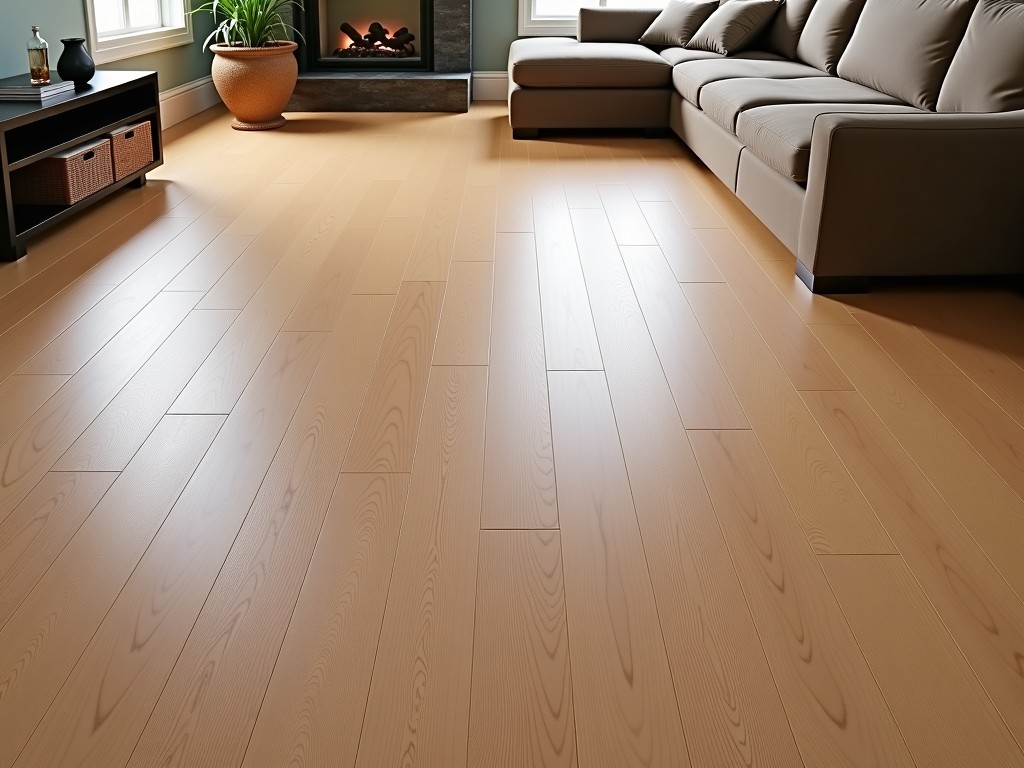
Mohawk’s click‑lock vinyl flooring consists of a homogeneous PVC core, a reinforced fiberglass layer for dimensional stability, and a wear layer whose thickness is specified in mils (typically 12 mil to 20 mil for commercial grades). The core density ranges from 1.4 g/cm³ to 1.6 g/cm³, providing resistance to indentation under static loads up to 250 psi.
The wear layer is coated with a UV‑cured polyurethane finish that achieves a Taber abrasion index below 50 mg loss after 1000 cycles (CS‑17 wheel, 1000 g load). A printed décor layer uses high‑resolution photochromic inks that meet ISO 105‑B02 colorfastness (≥ 6 grade after 200 h xenon exposure). The backing includes a 0.5 mm sound‑absorbing underlayment that reduces impact sound transmission by ΔLw ≥ 18 dB.
Indentation resistance measured per ASTM F970 shows ≤ 0.05 mm residual depth after a 750 psi static load for 24 h. Dimensional change after exposure to 80 % RH at 40 °C for 7 days is ≤ 0.15 % (length) and ≤ 0.10 % (width). Slip resistance (wet pendulum test) yields a SRV ≥ 45, satisfying R10 classification for commercial kitchens.
The click‑lock profile features a 2‑mm tongue and a 1.8‑mm groove with a 12° interlock angle, allowing a shear strength of 1.8 kN per joint before disengagement. Installation requires a flat substrate with tolerance ± 3 mm over 2 m; no adhesive is needed, and the floor can be floated over existing tile, concrete, or wood subfloors with a compatible vapor barrier.
In healthcare facilities, the flooring supports rolling loads of up to 300 kg per caster while maintaining a seamless surface that inhibits microbial growth (ISO 22196). Educational environments benefit from the low VOC emission (< 50 µg/m³) and the ability to withstand frequent chair movement without delamination. Light industrial zones (e.g., assembly lines) exploit the high impact resistance (ISO 23999‑1: ≥ 12 J) and chemical resistance to oils and solvents (ASTM D1308).
Each production lot undergoes inline thickness measurement (± 0.02 mm) and wear‑layer adhesion testing (ASTM D4541, ≥ 5 psi). Finished boards are sampled for static load indentation, chemical resistance, and dimensional stability per ISO 10582. AQL = 0.65 for visual defects; batches exceeding this threshold are reworked or scrapped.
Boards are stacked in cartons of 20 planks, each carton weighing approximately 18 kg. Cartons are placed on Euro‑pallets (800 mm × 1200 mm) with a maximum height of 1.2 m, stretch‑wrapped with 80 µm PE film, and corner‑protected. Pallets are labeled with batch code, product SKU, and QR code linking to the test certificate.
| Property | Typical Value | Test Standard |
|---|---|---|
| Wear Layer Thickness | 12–20 mil (0.30–0.51 mm) | ASTM F410 |
| Core Density | 1.4–1.6 g/cm³ | ASTM D792 |
| Abrasion Resistance | ≤ 50 mg loss (1000 cycles) | ASTM D4060 (Taber) |
| Static Load Indentation | ≤ 0.05 mm @ 750 psi, 24 h | ASTM F970 |
| Dimensional Change (RH/T) | ≤ 0.15 % L, ≤ 0.10 % W | ISO 10582 |
| Slip Resistance (Wet Pendulum) | SRV ≥ 45 (R10) | BS 7976‑2 |
| Impact Resistance | ≥ 12 J | ISO 23999‑1 |
To discuss technical specifications, request a formal quotation, or arrange sample shipments, please reach out using the form below.
Submit OEM InquiryNational patents
Vinyl flooring line
K+ SQ.M capacity
Founded