46
National patents
Stone Plastic Composite (SPC) rigid core flooring consists of a calcium carbonate core blended with polyvinyl chloride, topped with a transparent wear layer and a printed decorative film. This
Order this product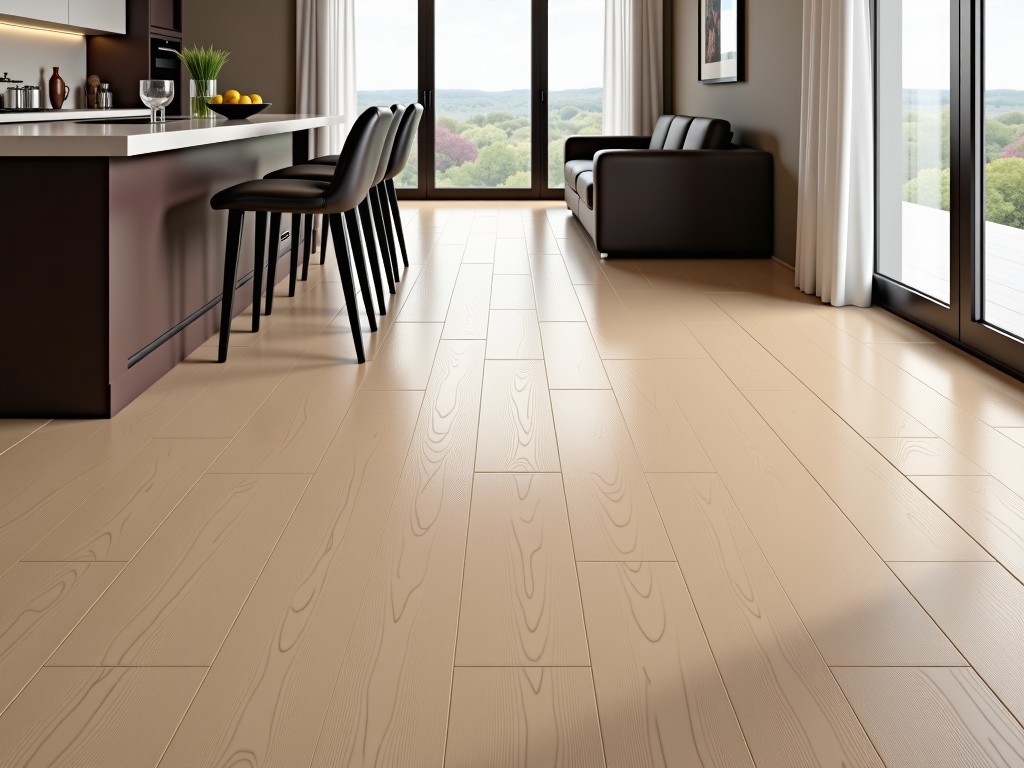
Stone Plastic Composite (SPC) rigid core flooring consists of a calcium carbonate core blended with polyvinyl chloride, topped with a transparent wear layer and a printed decorative film. This structure yields a product that exhibits dimensional stability under temperature fluctuations and resistance to moisture ingress.
| Property | Typical Value | Test Standard |
|---|---|---|
| Total thickness | 4.0 mm – 6.0 mm | ISO 24346 |
| Wear layer thickness | 0.3 mm – 0.7 mm | ISO 24340 |
| Density | 1.9 g/cm³ – 2.1 g/cm³ | ISO 1183 |
| Dimensional stability (heat) | ≤0.15 % after 6 h at 80 °C | EN 434 |
| Impact resistance | ≥1500 mm (large ball) | EN 13329 |
| Fire classification | Bfl‑s1 (EN 13501‑1) | EN 13501‑1 |
| VOC emissions | ≤0.5 mg/m³ (TVOC) | ISO 16000‑9 |
Raw limestone and PVC resin are weighed and fed into a twin‑screw extruder where they are melted and homogenized at approximately 180 °C. The molten compound is then forced through a die to form a continuous sheet of calibrated thickness.
The sheet passes through a series of embossing rollers that impart the chosen surface texture before being cooled on a calibrated conveyor. A UV‑cured coating is applied to the wear layer to achieve the specified abrasion resistance.
Finally, the flooring is cut to length, edges are milled to the selected locking profile, and each plank undergoes automatic optical inspection for surface defects before packaging.
Because the SPC core contains a high proportion of inorganic filler, the product exhibits negligible expansion or contraction when exposed to temperature changes, making it suitable for environments with fluctuating HVAC loads.
Manufacturers can adjust the core composition to achieve specific density targets, which influences acoustic transmission loss and underfoot feel.
In‑line thickness gauges monitor extrusion tolerance, maintaining variance within ±0.05 mm across the production line.
Samples from each batch are subjected to Taber abrasion testing; the resulting wear index determines the final AC rating.
Slip resistance is measured using the pendulum tester, with target R10 or higher for wet areas.
Final inspection includes a 100 % visual scan for surface defects and a dimensional check of length and width tolerances (±0.1 %).
Planks are stacked in layers separated by polyethylene film to prevent surface abrasion during transit.
Each pallet is secured with stretch wrap and corner boards, then placed inside a container with desiccant packs to maintain humidity below 60 % RH.
Standard pallet size is 1.1 m × 1.1 m, holding approximately 50 m² of flooring depending on thickness.
Q: Can dimensions be customized?
A: Yes, total thickness, wear layer, and panel length can be adjusted according to project specifications.
Q: What information is required for a quotation?
A: Project area, desired thickness, wear layer class, edge profile, and any specific decorative pattern.
Q: How are samples arranged?
A: Sample boxes containing up to five variations are shipped via express courier, freight collect or prepaid as agreed.
Q: What is the typical production lead time?
A: Lead time ranges from 2 to 4 weeks after receipt of confirmed drawings and deposit, depending on order size.
Q: How are export shipments protected against moisture?
A: Each pallet is wrapped in a polyethylene barrier, includes desiccant packs, and is loaded into containers with ventilation to maintain stable humidity.
To receive a detailed product data sheet, discuss customization options, or request a formal quotation, please provide your project requirements via the contact form.
Request Technical ConsultationNational patents
Vinyl flooring line
K+ SQ.M capacity
Founded