46
National patents
The flooring system consists of a PVC core, a reinforced fiberglass layer, and a wear‑resistant top coating, engineered to withstand continuous foot traffic and equipment loads in settings such as
Order this product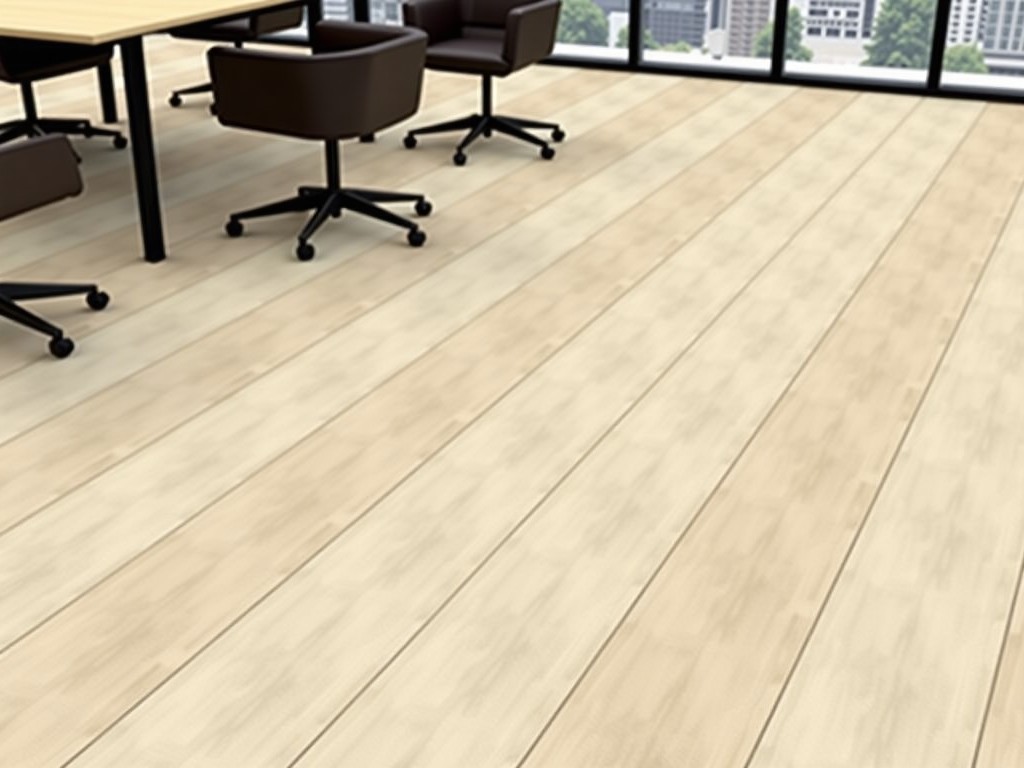
The flooring system consists of a PVC core, a reinforced fiberglass layer, and a wear‑resistant top coating, engineered to withstand continuous foot traffic and equipment loads in settings such as hospitals, schools, and retail centers.
A typical plank comprises four layers: a UV‑protected surface (0.15 mm), a wear layer (0.5–0.7 mm), a printed design film, and a PVC backing reinforced with fiberglass mesh (0.8 mm). The total thickness ranges from 4.0 mm to 5.0 mm depending on the wear‑layer grade.
The wear layer is measured in mils; a 20‑mil layer provides a Taber abrasion resistance of less than 0.05 g loss per 1000 cycles under a 500 g load, suitable for environments with frequent rolling loads.
Slip resistance is expressed as an R‑value; standard formulations achieve R10 (wet pendulum test) while anti‑slip additives can raise this to R12 without compromising flexibility.
| Property | Typical Value | Test Standard |
|---|---|---|
| Total thickness | 4.0–5.0 mm | ISO 24346 |
| Wear layer thickness | 0.5–0.7 mm (20–28 mil) | EN 429 |
| Dimensional stability (heat) | ≤0.15 % after 6 h at 80 °C | ISO 23999 |
| Residual indentation | ≤0.05 mm after 150 kg load | EN 433 |
| Chemical resistance | No change after 24 h exposure to 5 % NaOH | EN 423 |
| Fire rating | Bfl‑s1 (EN 13501‑1) | EN ISO 9239‑1 |
In healthcare facilities, the seamless surface reduces microbial harborage and tolerates frequent disinfectant wiping, while the wear layer endures stretcher wheels and cart traffic.
Educational institutions benefit from the floor’s low VOC emission (≤0.5 mg/m³) and its ability to attenuate impact sound by up to 15 dB, improving classroom acoustics.
Retail environments rely on the product’s stain resistance to oils and pigments, allowing quick cleanup of spills without permanent discoloration.
Each batch undergoes inline thickness monitoring with laser gauges, ensuring tolerance within ±0.05 mm before the sheet proceeds to embossing.
After lamination, samples are cut for Taber abrasion testing; only lots meeting <0.05 g loss advance to packaging.
Chemical resistance is verified by immersing specimens in a 5 % sodium hydroxide solution for 24 hours, followed by visual inspection for swelling or discoloration.
Final inspection includes a slip‑resistance pendulum test; any product falling below R10 is reworked or scrapped.
Thickness can be adjusted from 3.0 mm for light‑duty areas to 6.0 mm for heavy‑impact zones by varying the PVC core and wear‑layer proportions.
Wear‑layer mils are selectable in 5‑mil increments (15, 20, 25, 30) to match expected abrasion levels.
Surface finishes range from matte (gloss <10 %) to low‑sheen (gloss 10‑30 %) and can be embossed with wood, stone, or abstract patterns.
Edge profiles include straight, beveled, or interlocking designs, facilitating either glue‑down or floating installation methods.
Rolls are wound on 3‑inch core tubes, wrapped in polyethylene film, and placed on corrugated pallets with corner protectors to prevent edge damage during transit.
Each pallet carries a maximum of 20 rolls (approximately 500 m²) and is secured with PET straps; the total pallet weight stays under 1,200 kg for standard container loading.
Export shipments include a moisture‑barrier liner inside the pallet wrap to guard against condensation during ocean freight.
Standard specifications ship within 15 working days after receipt of deposit and confirmed artwork.
Custom wear‑layer thicknesses or special prints add 5‑7 days to the schedule, pending raw‑material availability.
Expedited air freight can reduce transit time to 3‑5 days for urgent projects, subject to carrier capacity.
Yes. Widths range from 183 mm to 200 mm and lengths from 1,200 mm to 2,400 mm; custom cuts are available upon request with associated tooling fees.
Project area, desired thickness, wear‑layer mil, finish type, edge profile, and delivery destination enable an accurate cost estimate.
Incoming raw materials are tested for PVC purity and fiberglass tensile strength; finished goods undergo thickness, abrasion, slip, and chemical resistance checks per ISO standards.
Standard roll packaging on pallets; optional crate packing for high‑value orders; both include moisture‑barrier liners.
Pallets are wrapped in stretch film, fitted with corner boards, and sealed with a moisture‑resistant barrier before containerization.
Fifteen working days for standard items; custom features add five to seven days.
Free A4‑size samples are shipped via express courier; freight charges are refundable upon order confirmation.
For technical data sheets, sample requests, or project‑specific quotations, contact our engineering team.
Request a QuoteNational patents
Vinyl flooring line
K+ SQ.M capacity
Founded