46
National patents
Homogeneous vinyl flooring consists of a single‑layer PVC compound where color, pattern and performance characteristics run through the entire thickness. Unlike layered products, there is no separate
Order this product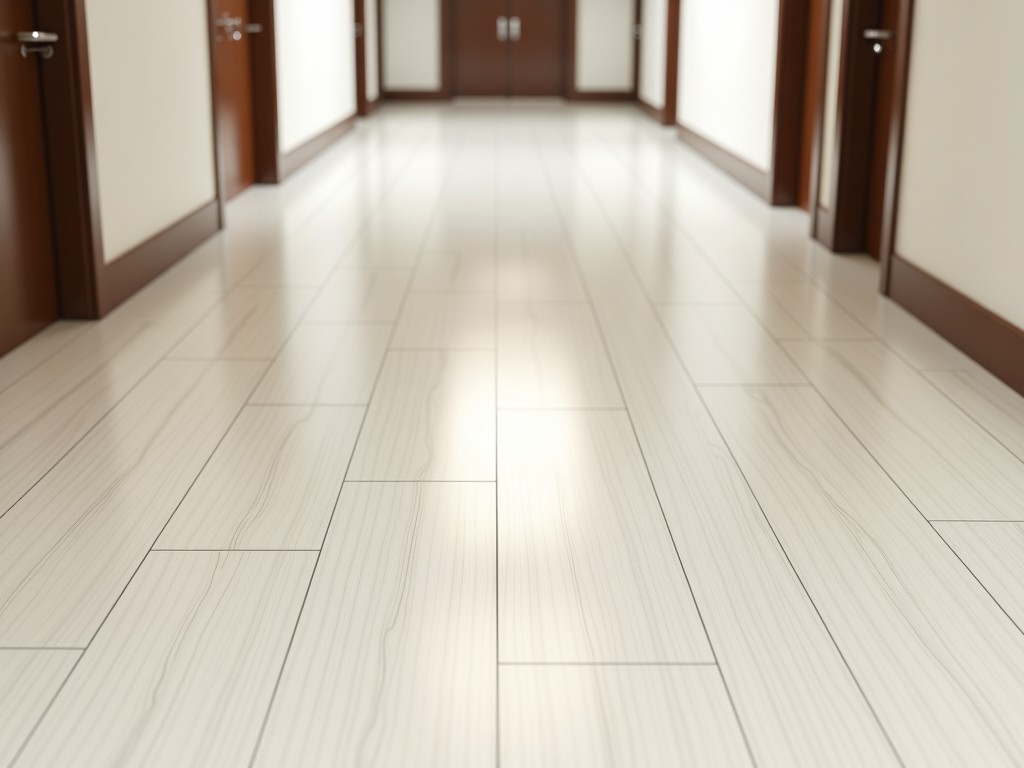
Homogeneous vinyl flooring consists of a single‑layer PVC compound where color, pattern and performance characteristics run through the entire thickness. Unlike layered products, there is no separate wear layer that can delaminate, which provides consistent slip resistance, chemical resistance and mechanical properties from surface to backing. This structural uniformity is a key factor for environments that demand long‑term durability and strict hygiene standards.
Typical technical parameters for hospital‑grade homogeneous rolls include a total thickness of 2.0 mm to 3.0 mm, a wear layer equivalent to the full thickness (since the material is homogeneous), static load resistance exceeding 2500 N, and a slip resistance rating of R10–R11 according to DIN 51130. The material achieves a fire classification of Bfl‑s1 (EN 13501‑1) and total volatile organic compound (VOC) emissions below 0.5 mg/m³·h, meeting stringent indoor air quality requirements.
Hospitals benefit from the seamless installation possible with wide rolls, which reduces joints where pathogens can accumulate. The homogeneous surface supports rigorous cleaning regimens, including exposure to alkaline detergents, disinfectants and occasional steam cleaning, without surface degradation. Additionally, the flooring can be formulated with static‑dissipative additives (surface resistance 10⁶–10⁹ Ω) to protect sensitive electronic equipment in operating rooms and imaging suites.
Customization is driven by project‑specific needs: roll widths range from 1.5 m to 2.5 m, lengths can be cut to exact room dimensions (up to 50 m per roll without splices), and thickness can be adjusted between 2.0 mm and 3.5 mm for high‑traffic zones. Color palettes are achievable through pigment loading, allowing subtle, low‑contrast tones that reduce visual glare while maintaining a clean aesthetic. Surface treatments such as antimicrobial silver‑ion incorporation or UV‑cured polyurethane coatings can be added to enhance infection control and wear resistance.
Manufacturing begins with a carefully balanced PVC resin blend, selected plasticizers for flexibility, calcium‑zinc stabilizers for heat resistance, and optional functional additives. The mixture is fed into a calendering line where it is formed into a sheet of uniform gauge, then cooled and embossed if a texture is required. In‑line monitoring systems track thickness variance within ±0.05 mm and detect any foreign particles before the sheet is wound onto cores for export.
Quality control follows a layered philosophy: raw material batches are tested for melt flow index and phthalate content; each production run undergoes inline gauge verification, wear layer adhesion peel tests (minimum 1.5 N/mm), slip resistance pendulum testing, and chemical resistance immersion according to ISO 26987. Finished rolls are sampled for dimensional stability after 24 h at 70 °C/90 % RH, ensuring that the product will maintain flatness during installation and service life.
| Parameter | Typical Value (Standard) | Customizable Range |
|---|---|---|
| Total Thickness | 2.5 mm | 2.0 mm – 3.5 mm |
| Slip Resistance (DIN 51130) | R10 | R10 – R13 |
| Static Load Resistance | 2500 N | 2000 N – 3500 N |
| Fire Classification (EN 13501‑1) | Bfl‑s1 | Bfl‑s1 – Cfl‑s1 |
| VOC Emission (ISO 16000‑9) | 0.4 mg/m³·h | 0.2 – 0.6 mg/m³·h |
| Surface Resistance (Antistatic) | 10⁸ Ω | 10⁶ Ω – 10⁹ Ω |
Typical hospital applications include patient wards, where low‑glare, easy‑to‑clean surfaces reduce visual fatigue for staff and minimize bacterial harborage; operating theatres and procedure rooms, which demand static‑dissipative properties to protect sensitive equipment and allow rapid sterilization; laboratories and pharmacies, where chemical resistance to solvents and disinfectants is essential; and circulation corridors, where high roll width permits seamless runs that limit tripping hazards and simplify maintenance schedules.
Q: Can the roll dimensions be customized to match specific room layouts?
A: Yes. Widths are adjustable between 1.5 m and 2.5 m, and lengths can be cut to exact measurements without splices, subject to minimum order quantities.
Q: What information is required to generate a quotation?
A: Project area, desired thickness, width, any functional treatments (antimicrobial, antistatic, fire‑retardant), color reference, and delivery destination.
Q: Which material options are available for hospital environments?
A: Base PVC compound with optional plasticizer packages for flexibility, calcium‑zinc stabilizers, antimicrobial silver‑ion additives, UV‑cured polyurethane wear enhancers, and flame‑retardant fillers.
Q: How is quality inspected before shipment?
A: Each roll undergoes dimensional checks, thickness variance testing, slip resistance pendulum measurement, chemical immersion per ISO 26987, and visual inspection for surface defects.
Q: What packaging methods protect the rolls during export?
A: Rolls are wrapped in polyethylene film, placed on sturdy cardboard cores, and secured in corrugated boxes or palletized with edge protectors to prevent deformation and moisture ingress.
Q: What is the typical production lead time?
A: Lead times range from 3 to 5 weeks depending on order complexity and current capacity, with exact schedules confirmed at quote stage.
Q: How can samples be arranged for evaluation?
A: Small sample swatches (300 mm × 300 mm) can be dispatched via express courier upon receipt of a formal request; larger panel samples are available for qualifying projects.
To discuss technical specifications, obtain a detailed quote, or arrange sample shipments, please contact our export team.
National patents
Vinyl flooring line
K+ SQ.M capacity
Founded