46
National patents
Marmoleum is a linoleum-based floor covering manufactured from oxidized linseed oil, wood flour, cork dust, and natural pigments pressed onto a jute backing. The material forms a homogeneous sheet
Order this product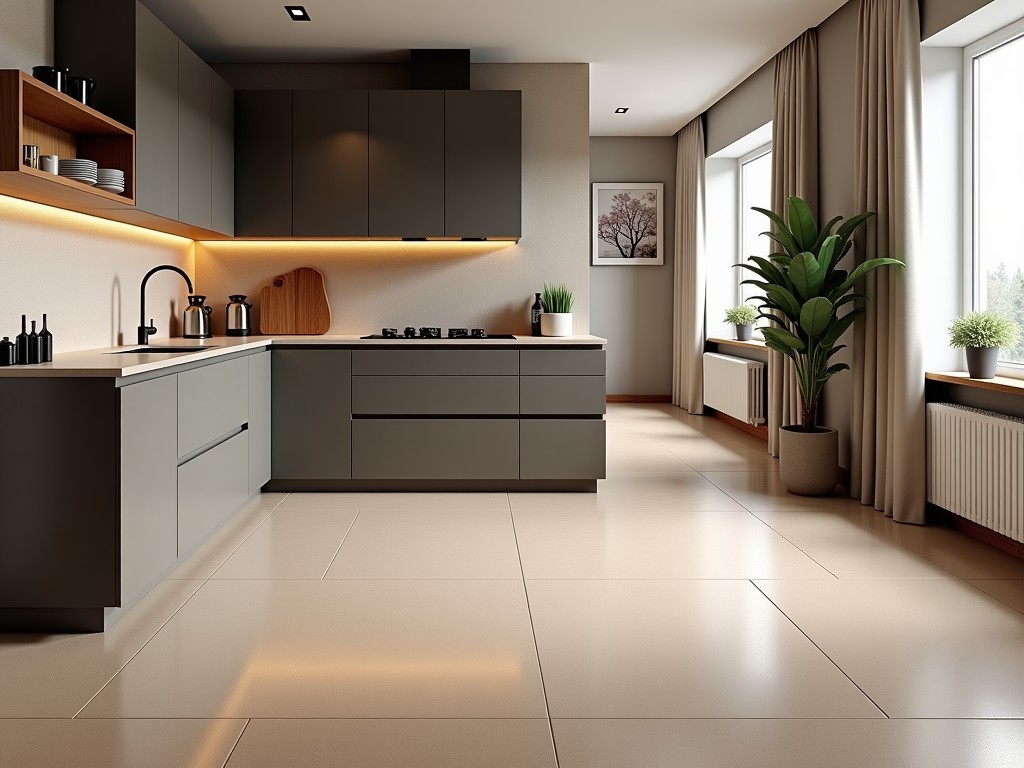
Marmoleum is a linoleum-based floor covering manufactured from oxidized linseed oil, wood flour, cork dust, and natural pigments pressed onto a jute backing. The material forms a homogeneous sheet that cures over time, developing increased hardness and durability. For kitchen environments, the seamless nature and inherent resistance to water and oils make it a practical choice for both commercial and residential settings.
The wear layer consists of a cured linoleum matrix approximately 2 to 3 mm thick, providing the walking surface. Beneath this, a design layer holds the pigment pattern, which is embedded throughout the thickness rather than printed on top. A jute backing supplies dimensional stability and allows adhesion to the subfloor with appropriate adhesives.
Standard rolls are supplied in widths of 2 m and lengths up to 30 m, with overall thicknesses ranging from 2.0 mm to 3.2 mm. Custom cutting to specific panel sizes, such as 600 mm × 600 mm tiles or rectangular strips, is available upon request. Edge profiles can be supplied square, beveled, or with a pre‑formed cove for seamless wall‑to‑floor transitions. All dimensions are held to a tolerance of ±0.1 mm for thickness and ±1 mm for width and length.
The coefficient of friction (COF) measured per ASTM D2047 typically falls between 0.5 and 0.6, providing slip resistance suitable for wet kitchen floors. Resistance to common kitchen chemicals—such as vegetable oils, animal fats, and mild acidic cleaners—is demonstrated by no visible swelling or discoloration after 24 hour immersion tests. The material exhibits a wear rating of 30 kPa according to ISO 10582, indicating suitability for moderate to heavy foot traffic. Antimicrobial additives are not required; the linoleum matrix naturally inhibits bacterial growth due to its pH and oxidative curing. Sound absorption coefficients average 0.15 NRC, contributing to reduced noise levels in busy kitchen spaces.
A clean, dry, and level subfloor with a maximum moisture content of 2 % (by weight) is recommended before installation. Adhesives compatible with linoleum, such as low‑VOC acrylic or urethane‑based spreads, should be applied at a rate of 200–250 g/m². Seams are typically heat‑welded using a compatible welding rod to create a continuous, water‑tight surface, and expansion joints are placed at perimeter intervals of 8 m to accommodate dimensional change.
Each production lot undergoes thickness measurement at five points across the width, with acceptance criteria of ±0.1 mm from nominal. Visual inspection checks for color uniformity, surface defects, and embossing consistency under 500 lux lighting. Accelerated aging tests per ISO 23999 confirm that the material retains at least 85 % of its initial tensile strength after 500 hours of UV exposure.
| Property | Typical Value | Customizable Range |
|---|---|---|
| Overall Thickness | 2.5 mm | 2.0 mm – 3.2 mm |
| Wear Layer Thickness | 0.7 mm | 0.5 mm – 1.0 mm |
| Weight | 2.8 kg/m² | 2.5 kg/m² – 3.5 kg/m² |
| Slip Resistance (COF) | 0.55 | 0.50 – 0.60 |
| Chemical Resistance (Oil) | No change after 24 h | Custom formulations available |
Seamless installation eliminates crevices where food particles and liquids can accumulate, simplifying cleaning routines and reducing bacterial harborage. The floor’s resistance to animal fats and vegetable oils means that spills from cooking processes do not cause staining or degradation. Because marmoleum is antistatic, it minimizes the attraction of dust and particulate matter in environments with frequent dry‑goods handling. Additionally, the material’s low thermal conductivity helps maintain a comfortable underfoot temperature in areas where workers stand for extended periods.
The primary raw materials—linseed oil, wood flour, cork, and jute—are derived from renewable agricultural sources. Production emits low levels of volatile organic compounds, typically below 50 g h⁻¹ m⁻², contributing to improved indoor air quality. At end‑of‑life, the flooring can be mechanically recycled into new linoleum products or used as a carbon‑neutral fuel in energy recovery facilities.
Yes. Rolls can be slit to custom widths, and lengths can be cut to exact panel sizes. Tolerances are held to ±0.1 mm for thickness and ±1 mm for length and width, ensuring tight fit‑up with minimal waste.
Project planners should provide the total area to be covered, desired thickness, any specific color or pattern references, and details on subfloor condition. If edge profiling or custom cuts are needed, a sketch or CAD file helps accelerate the quote.
Each roll undergoes thickness verification, visual inspection under standardized lighting, and a short‑term chemical resistance spot test. Documentation of results is included with the shipment upon request.
Ready to discuss your custom marmoleum kitchen flooring needs?
Contact Our Technical TeamNational patents
Vinyl flooring line
K+ SQ.M capacity
Founded