46
National patents
Seamless vinyl flooring is produced as a continuous sheet, eliminating joints that can trap dirt or moisture. The product consists of a polyvinyl chloride (PVC) core reinforced with a fiberglass mat,
Order this product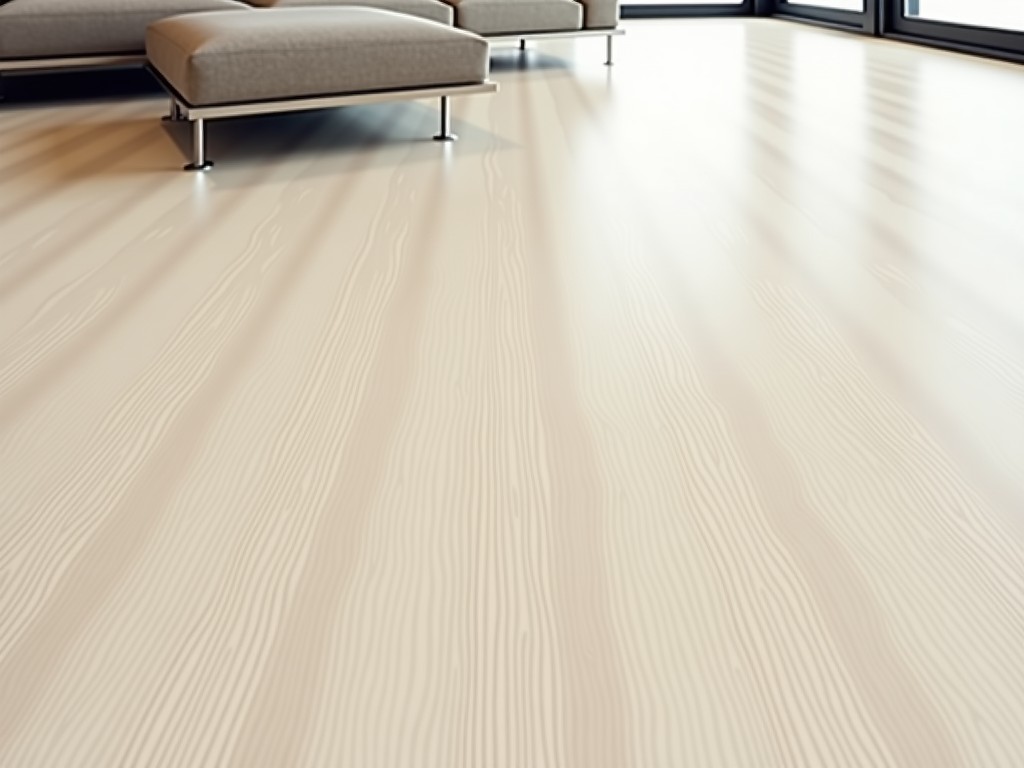
Seamless vinyl flooring is produced as a continuous sheet, eliminating joints that can trap dirt or moisture. The product consists of a polyvinyl chloride (PVC) core reinforced with a fiberglass mat, a clear wear layer, and a printed design film. This construction delivers dimensional stability under temperature fluctuations and resistance to chemical spills common in industrial environments.
The core typically contains 55‑65% PVC resin, plasticizers for flexibility, and stabilizers to prevent degradation from UV exposure. A fiberglass reinforcement layer, usually 0.1 mm thick, is embedded to reduce expansion and contraction. The wear layer, made of pure PVC, ranges from 0.3 mm to 0.7 mm thick and provides abrasion resistance. A printed film beneath the wear layer replicates textures such as concrete, metal, or wood grain.
Raw materials are blended in a high‑speed mixer, then fed into a calendaring line where the sheet is formed to precise thickness. The fiberglass mat is laminated during the calendaring stage to ensure full encapsulation. After cooling, the sheet passes through a printing station for the design layer, followed by a coating station that applies the wear layer. The final product is inspected for thickness uniformity before being rolled.
| Property | Typical Value | Test Standard |
|---|---|---|
| Overall Thickness | 2.0 mm – 3.0 mm | ASTM F386 |
| Wear Layer Thickness | 0.3 mm – 0.7 mm | ASTM F410 |
| Dimensional Stability (ΔL/L) | ≤0.15% after 8 h at 80 °C | ASTM F2199 |
| Slip Resistance (R value) | R9 – R11 (depending on emboss) | DIN 51130 |
| Fire Rating | Bfl‑s1 (EN 13501‑1) | EN ISO 9239‑1 |
In warehouses, the flooring’s resistance to fork‑lift tire marks and its ability to withstand static loads exceeding 5 t/m² reduce maintenance cycles. Healthcare facilities benefit from the non‑porous surface that inhibits microbial growth and permits easy cleaning with hospital‑grade disinfectants. Manufacturing plants with exposure to oils, solvents, or alkaline cleaners rely on the chemical‑resistant wear layer, which shows less than 5% weight change after 24 h immersion in ISO 105‑E04 test fluids.
The product’s acoustic insulation (ΔLw ≈ 15 dB) contributes to quieter environments in assembly lines, while its thermal conductivity (≈0.15 W/m·K) helps maintain stable floor temperatures in cold‑storage zones.
Inline gauges monitor thickness at 10 cm intervals; any deviation beyond ±0.05 mm triggers an automatic adjustment. After production, each roll undergoes a 3‑m tensile test to verify elongation at break (>150%) and tear strength (>20 N/mm). Samples are submitted to accredited labs for slip resistance, fire performance, and phthalate content (REACH compliance). Documentation includes a material safety data sheet (MSDS) and a test report batch number traceable to the extrusion line.
Rolls are wrapped in a low‑density polyethylene (LDPE) film to protect against moisture and UV during transit. Protective corner guards are applied to both ends, and the roll is placed on a wooden pallet with a load capacity of 2 t. Pallets are stacked no higher than two levels to prevent deformation. For containerized shipments, each 20‑ft container holds approximately 14 pallets, optimizing weight distribution and reducing handling costs.
Yes. Thickness, width, length, wear‑layer thickness, and edge profile can be adjusted to match project specifications. Custom lengths beyond 30 m are produced with a factory‑spliced joint that maintains the same performance as seamless sections.
To provide an accurate quote we need the intended application area (square meters), desired thickness and wear‑layer, any specific slip‑resistance rating, color or pattern reference, and delivery destination. If the project requires special certifications (e.g., ISO 9001, ISO 14001) please indicate them at this stage.
Every roll receives dimensional checks, visual inspection for surface defects, and mechanical testing per the standards listed in the technical table. A final audit confirms that the batch matches the approved sample before release.
Standard packaging includes LDPE film wrap, corner guards, and palletization. For extra‑long rolls or high‑value orders we offer additional edge protection with cardboard sleeves and moisture‑barrier bags.
Lead time ranges from 10 to 20 working days depending on order complexity and current plant capacity. Expedited runs are available for critical projects, subject to machine availability.
For technical consultation or to receive a detailed quotation, please contact our sales team. Provide your project specifications and we will respond with a tailored solution within one business day.
National patents
Vinyl flooring line
K+ SQ.M capacity
Founded